Through Sat 1/28
A present trend in entertainment is storytelling before an audience. The Moth: True Stories Told Live is one of NPR’s highest-rated offerings. The publicity for the show states, “The Moth is deeply rooted in the desire [of humans] to connect with each other through shared experiences in stories.” According to its blog site, though there are many opportunities nationwide to experience firsthand The Moth readings, none are being staged in the Cleveland area.
Don’t let that deter you from having a storytelling experience. Playwrights Local is presenting the world premiere of This Is Not About My Dead Dog, Cleveland playwright and actor Amy Schwabauer’s one-woman confession, as she knows it, or what she wants us to know about it.
Schwabauer, a 2011 Cleveland State University graduate, studied sketch comedy writing at Second City in Chicago. The improv and sketch training is obvious in both the script and the well-acted presentation of the piece which was originally workshopped in Playwright Local’s 2016 Play Lab. The show is directed by Dale Heinen, director in residence at Playwrights Local, a director/dramaturge focusing on new works.
Presented in 20+ sketches, Schwabauer takes us on a journey through her “so-called” life, much of which took place in Cleveland Heights. It is performed on a platform, with the audience curving around it. On the stage are a series of props which the actress/playwright uses to help tell her stories. Included are a desk, chair, two hassocks, a doll and dollhouse, and a rag rug. The back wall of the theater is adorned with three headboards.
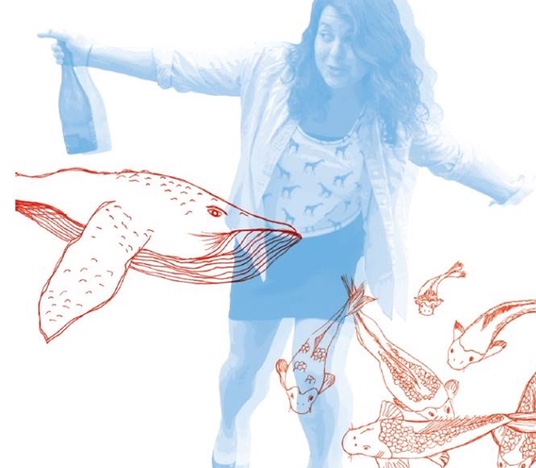
The intermissionless staging finds a drunk Amy, wine bottle in hand, looking into the water of the lagoon situated in front of the Cleveland Museum of Art, observing the goldfish (carp) and wondering what the fish do when the water freezes in winter. As we learn later, the carp descend deep into the water below the three-foot ice crest and go into a state of dormancy, saving themselves from being frozen.
Through other interjections we are exposed to what happens to a whale who gets separated from its pod and tries to find a new group, but whose voice and language are not recognized by whales in other pods, so the isolate must remain alone. In addition, we learn what human reactions to full moons, the traditions of the Catholic church regarding sex, having a “fake boyfriend,” and the carp tale, all have to do with this Amy.
The “morals” are interspersed, sometimes in chronological order, sometimes randomly in “real” stories which include Amy’s belief when she was growing up that she was a boy without a penis; her exposure to alcohol at her brother’s house party when she was six; her love for her dog Scout; her status as the family’s bonus baby; a trip to D.C. to visit her sister where she realized she was invisible; the tale of the “Larchmere” tree; her grandfather’s suicide in the family garage; why she cut off her hair; the trials of being in junior high; life in Catholic school; a tale of drinking rum in the bathroom with a boy; her first fling at making out; the tribulations of “required” virginity; the problems with Tampons; a sonnet she wrote to Brad; the search for a boyfriend; why college is the worst idea in the world; how to be shy at a party; why her attempts to stalk a man named Tyler lead to her being designated as a “make-out whore;” why she is not good at sex; and how an intervention by the Cleveland Heights police helped her become aware of who she really is.
Sounds like a lot. It is. The script could be cut by at least ten minutes, the number of drunk scenes compressed, the death of Scout told only once, a lot of the vomiting sequences eliminated and some bright light among the darkness interjected. Only so much self-pity works. After a while the whole thing becomes an endless loop of drunk “mea culpa, mea culpa, mea culpa” and loses some of its impact.
CAPSULE JUDGMENT: The sold-out largely mid-20s female audience responded well to the tales of self-loathing. Some even shed tears at the end. The stories obviously hit a chord with them. Some adjustments in the script could expand the appeal to a wider audience and provide a better theatrical experience.
For tickets and info go to playwrightslocal
[Written by Roy Berko, Cleveland Critics Circle, American Theatre Critics Association]