Through March 29
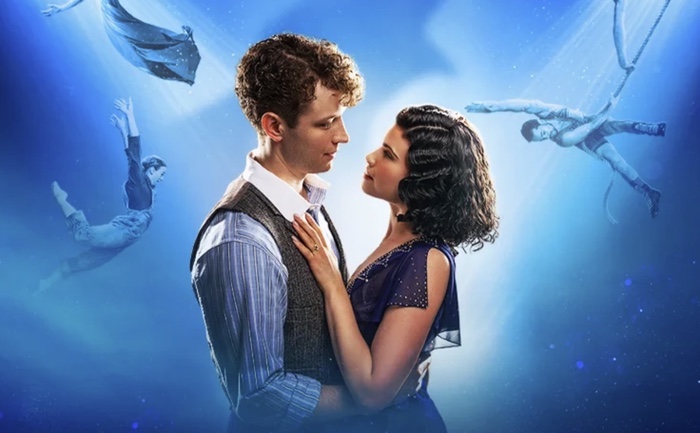
What would it be like to run away and join a circus? Water for Elephants, the latest national Broadway series musical currently at Cleveland’s Connor Palace Theatre, gives one answer.
Mostly set during the 1930’s Great Depression, the show combines breathtaking acrobatics and clever puppeteering with a touch of romance. It’s adapted from the novel (highly recommended) of the same name and features original direction by Jessica Stone, with book by Rick Elice, and music and lyrics by Pigpen Theatre Company.
The story begins with the elderly Mr. Jankowski (Robert Tully) remembering his 1930’s self. Turns out he did run away and hop on a passing circus train. As he tells the story, we see the younger version of Jacob Jankowski (Zachary Keller) take over.
He takes a temporary job with the circus and, when it is discovered he has training in veterinary medicine, he’s asked to stay with the travelling show. He agrees.
One big attraction for Jacob, besides the animals (we meet puppet versions), turns out to be Marlena (Helen Krushinski). Unfortunately, Marlena is married to August (Connor Sullivan), the ringmaster. Even more unfortunately, August is prone to violent rages and takes his fury out on people and animals.
Yes, that turns out badly (especially for August). Still, in a way, all is happily resolved, at least as the older Jacob remembers those “good old days.” The convoluted story works better in a novel because the story doesn’t require as much compression as a stage musical.
Other characters were played by Javier Garcia (Camel), Ruby Gibbs (Barbara), Grant Huneycutt (Wade), and Tyler West (Walter). The ensemble included Fran Alvarez Jara, Yves Artieres, Chris Carsten, Adam Fullick, Nancy Gutierrez, Ella Huestis, Sam Kellar-Long, ZaKeyia Lacey, Andrew Meier, Marina Mendoza, John Neurohr, Bradley Parrish, Carl Robinett, Summer Severin, Serafina Walker, and Yemie Woo.
As we might expect at a circus, the acrobatics, by a cast celebrating various body types (being chubby or short is no longer an excuse), stole the show.
And special mention to the puppeteers, especially the team working in synch to bring Rosie the elephant to life. Not all musicals feature an elephant with fluttery eyelashes (and what turns out to be a passionate feminist heart). Other visually striking effects, such as a fairly believable train cars rumbling down the track, also enlivened the production.
Over a dozen songs, accompanied by a small pit orchestra conducted by Sarah Pool Wilhelm, help tell the story. Their titles reveal key story elements, such as “The Road Don’t Make You Young,” “Squeaky Wheel,” “Zostan,” and “I Choose the Ride.”
Bottom Line: Like any good circus, Water for Elephants revels in action. It’s not boring even when it’s confusing because it’s about being human. Life, it argues, is like carrying water for elephants—a constant process.