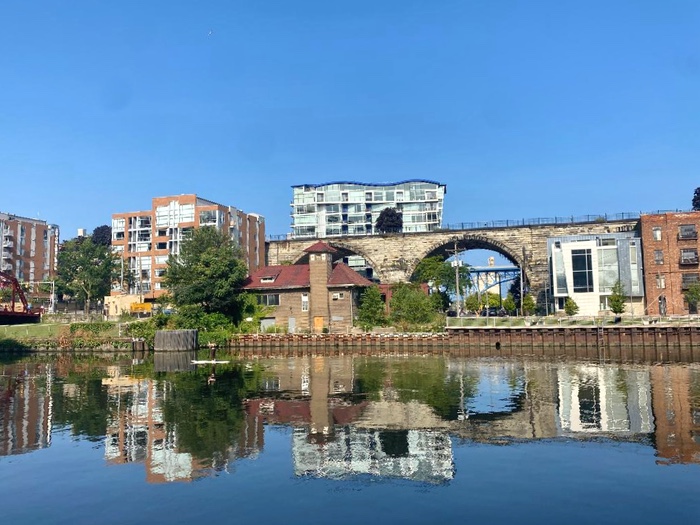
The City Centre Historic District Take-a-Hike Tour begins at the Flat Iron in the Flats on Saturday mornings at ten. It was an interesting tour. My biggest takeaway was that the Cleveland City Centre Historic District was a planned neighborhood envisioned as Cleveland’s industrial and commercial center in 1833. Half hidden in an overgrown hollow off the sidewalk on Columbus Road, the Gravity Place map shows the short-lived vision that died with an economic downturn in 1837. The inhospitable humid summers and harsh winters of the Flats didn’t help.
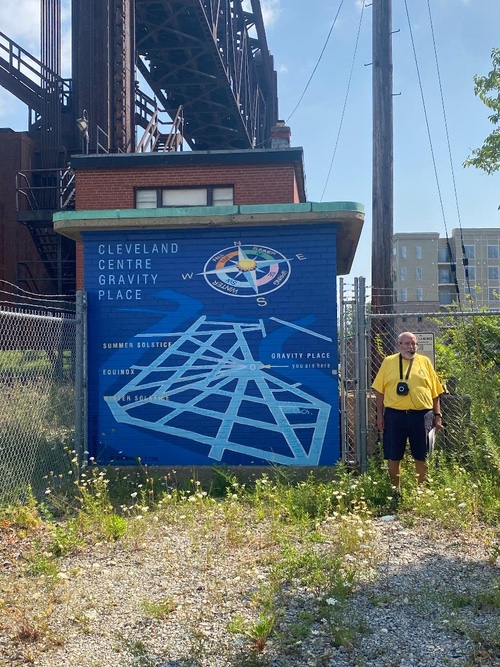
At the time, canal boats ferried goods up and down the canal, mills created product to take to towns further south, and immigrants were arriving in a steady stream from Europe. Since it was where commerce happened, the streets were laid out like sunrays from a point on Columbus Road Peninsula called Gravity Point, which explains the triangular intersections and buildings in the present-day Flats. An economic downturn in 1837 and the humid climate put an end to the idea, and Public Square, on the bluff above the Cuyahoga River, became Cleveland’s downtown.
Our tour guide began with a tribute to Tim Donovan, who served as Canalway Partners’ first executive director from 1990 until his retirement in 2020. He dedicated much of his life to the development of the Ohio & Erie Canalway National Heritage Area and the extension of the Ohio & Erie Canal Towpath Trail. His work caused Congress to recognize the Ohio & Erie Canalway as a National Heritage Area. Donovan also put energy into Cleveland History Days and co-founded the Take-a-Hike program.
Tim died on August 13th. As we walked around the Flats and learned the history of the area and new development, we thought of Donovan and his devotion to Cleveland. The Flats was alive with walkers, picknickers, and amateur photographers. Some people just sat on benches and watched.
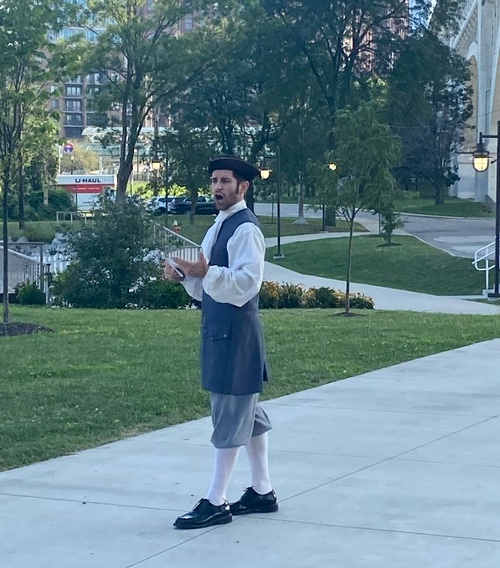
We met up with a young Moses Cleaveland near the Detroit-Superior Bridge. It’s hard to imagine that he’s lived for over two centuries! The actor was dressed as the Connecticut lawyer would have been in the 1700s. We had the impression that he didn’t know the job he was getting into when he was put in charge of surveying the wild wooded land owned by six nations on Lake Erie for the Connecticut Western Reserve.
Today, we can enjoy beautiful green space in our industrial valley close to Lake Erie. That serene walk-in-the-park feeling is much different from the noise of transportation and industry that caused us to think of the Flats as rough and dirty. If you stand and look around at the remnants of manufacturing, you can imagine the noise of machinery shops’ machines, the hammering and pounding of blacksmiths, and grain being milled. At the end of their shifts, workers walked out the doorways in clothes that they peeled off before entering their homes at the end of the day.
This past week, the Cleveland Metroparks commissioners approved a partnership with Ceres + LaPine Development to transform part of the former City Centre on the Columbus Peninsula into a mixed-use riverfront destination, which will include the Grain Craft silos and the Catanese Classics seafood building. Just recently, the Cuyahoga County Planning Commission has recommended an 18-mile series of parks and trails to connect with the Towpath Trail and Whiskey Island. And there’s a plan for a boardwalk between Merwin’s Wharf and Settler’s Landing.
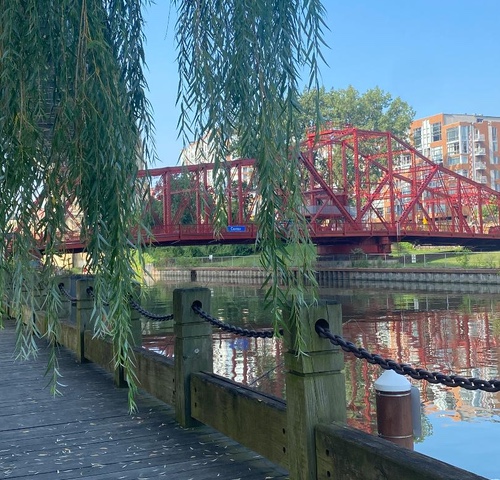
We learned more about the Cuyahoga River bridge wars between Ohio City and Cleveland. The original bridge was a log bridge. Half the logs belonged to Ohio City and half to Cleveland. The commercial competition became so fierce that some Cleveland citizens removed their logs, leaving Ohio City without a way to cross the wide river. The matter was eventually settled by a judge and became a non-issue once the two towns were combined in the 1854 merger. The log bridge was located where today’s Center Street swing bridge operates today.
Eighteen bridges have connected the east and west banks of the river over the years. Sandstone remnants of the Superior Viaduct Bridge, completed in 1878 as the city’s first high-level bridge, remain on both sides of the river. Today, people can visit a public park on top of the two arched sections that have been preserved on the west bank. It was supplanted by the higher Veterans Memorial Bridge, whose construction began in 1912.
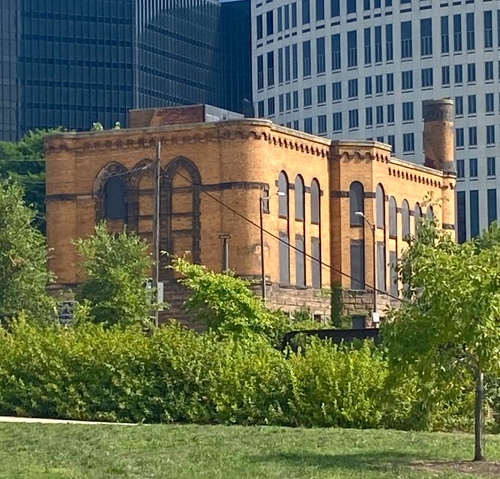
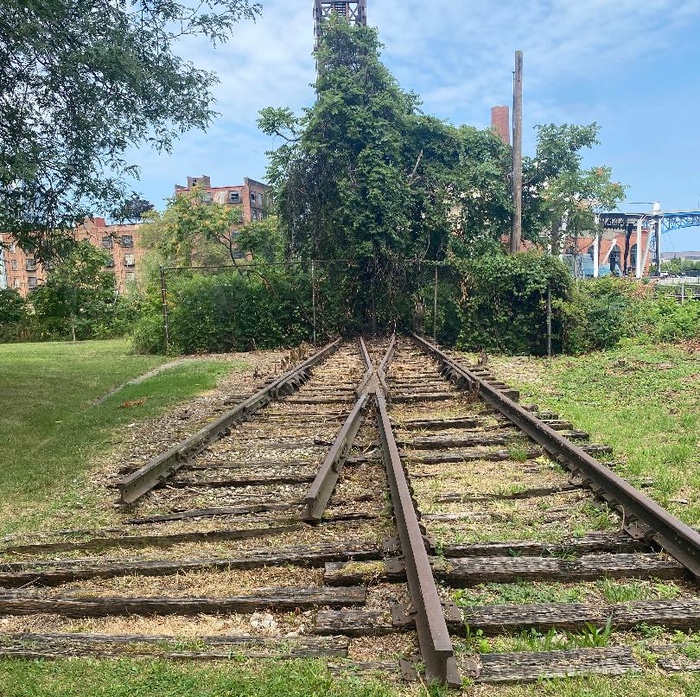
Next time I visit the Flats, I’ll be a better observer than in the past. Our guide pointed out abandoned railroad tracks at Canal Lock 44. Remnants of bridges can be found in a number of locations. The streets that were part of the Gravity Place vision are named for Old Country places that were original homes of immigrants arrived. The yellow brick building called the B&O station, built in 1899, still stands on a hill overlooking the flats—I’d like to get a better look at the building that will possibly be restored. I want to see the Cereal Foods Mill, one of the oldest structures in the district and one of thirteen mills that operated on the river, close up.
We ended our tour at the Flat Iron Cafe, Cleveland’s oldest Irish bar, in the building that was originally a four-story boarding house when it was built in 1890. The pub opened in 1910 at the corner of Center Street and Merwin Avenue. When the top two floors burnt, they were lopped off, and today the top floor of the building is used as a banquet room. It’s rumored that ghosts of the “ladies of the night” who served customers at the boarding house still roam the rooms. The authentic Irish pub still offers good food and drink and historic ambience.
The Cuyahoga River and its riverbanks are where Cleveland was born. I now have a greater appreciation for its early days. The buildings are always in the background, but they are our history and an important part of the scene while walking to a restaurant or concert venue. The Take-a-Hike tour spiked my interest, and I will go back and explore and linger on future Saturday mornings now that I have a better understanding of the heart of our city.
One Response to “Take a Hike to Learn About Cleveland’s History”
Bobbi Reichtell
Thanks for the story. I felt like I was along on the tour! And for the mention of my visionary friend Tim Donovan.