
Through Sat 1/23
“This happened…”
Yes, it did. In 1966 Cleveland. The Hough riots. The riots occurred for numerous reasons. They were mostly found in the social conditions that existed in Cleveland’s ghetto and also in a city that didn’t seem to have the time or wherewithal to care enough to try to reach out and empower a broken community — a community that wanted to be better, but was so frustrated over years of being beat down.
“The spark is all you need.”
That spark was ignited on July 18, 1966, when someone posted a sign outside the 79’s bar, situated on the southeast corner of East 79th Street and Hough Avenue. It read, “No Water for Niggers.”

An argument ensued for several reasons, and before the night was over, Joyce Arnett, a black 36-year-old mother of three, was shot dead when she called from a window, trying to get permission to go home and check on her children.
The next day, Ohio Governor James A. Rhodes activated 1,600 local members of the National Guard to keep order. That didn’t save Percy Giles, a black 38-year-old divorced father of two. He was shot and killed on his way to help a friend protect his business.
On the third night, five people were wounded, including a woman and her two children. On the fourth night, Sam Winchester, a 54-year-old black man, was killed while walking to a bus stop. On the fifth night, a trio of white men shot 29-year-old Benoris Toney, a black man sitting in his car in a nearby Euclid Avenue lumber yard. On the sixth and final day, rain helped settle the outbursts, as if the universe couldn’t handle it anymore, and cried for the pain and misery that was visceral for every human being involved. There were claims that the riots were too organized and that a Communist influence must be involved. But it didn’t matter as to the details. There is an argument that the city has never fully recovered.
Years later, enter the fierce and inventive Pandora Robertson, creator and director of Incendiaries, and also co-founder and co-director of the Ohio City Theatre Project. As she describes her artistic being, she states, “I believe my job as an artist is to tackle difficult topics and inspire others to venture out into the unknown.”

I would think that in this case, the unknown could also be a question of whether we are all a bit racist and don’t want to admit it. What Robertson has done in this expanded piece, which began as a segment in the Cleveland Public Theatre production of Fire on the Water, a series of short plays inspired by or connected to the burning of the Cuyahoga River, is present the events of the Hough Riots in full detail, dramatically trimmed to 50 minutes.
In an athletic performance art demonstration of determined force, seven actors — fierce activists — take the stage and commence telling the tale of a disturbing time in Cleveland history. And when you add in the raw emotional feelings around the killing of Tamir Rice, you slowly realize that the deep-rooted fears from 1966 are still alive and well.
The storytellers are Brittni Shambaugh Addison, Wesley Allen, Ashley Aquilla, Laprise Johnson, Daniel McNamara, Randi Renee and Chris Walker. They tell the story on a bare set, except for folding chairs and a large table. The physically demanding pace asks for the actors to constantly use the chairs and table to create cars, home, businesses and various locations to provide the story a setting and propel the story forward. It is an impressive artistic physical display.

Throughout the piece, there is a cacophony of sound mirroring the riotous atmosphere of the riots. This adds an underlying disturbance throughout the play. But the strongest moments come when the play and sound slow down and subside to reveal the painful reality that must be communicated. These more distinct sections of the play are powerful and serve the purpose to arouse a need to understand what happened and recover from what did happen to so many.
As the play moves forward and continues to grow, I hope that even more sections are allowed to be more exposed and that some of the physicality is geared more towards a natural movement than just movement. But those distracting moments are few. The piece has a stronger base than Bernie Sanders at the point. The hardest and the best solution to what happened at the Hough Riots is education. It will be a never-ending task. But, it will always be important to remind people … “This happened…!”
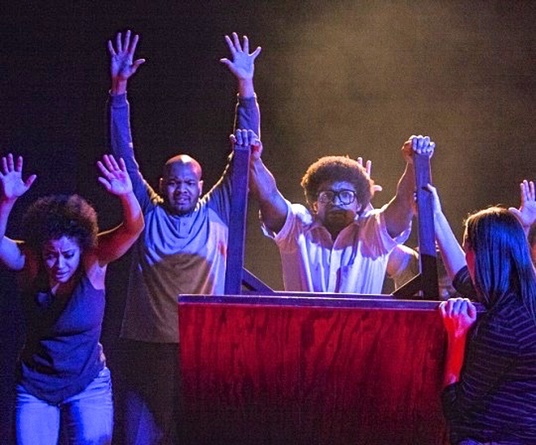
The creative team includes Robertson, whose gifted storytelling and casting keep on pushing us to look inside and outside; lighting designer Benjamin Gantose who created a deeply moving palate of light that infused the storytelling with a piercing starkness; sound designers Darryl Dickenson and Patrick Stoops, whose provided the piece’s edgy feel; costume designer Inda Blatch-Geib, whose designs seemed to make every performer feel at ease and comfortable in their design, which enabled them to engage more viscerally; and scenic designer Ian Petroni, whose simple design encompassed a disturbing reality.
The team also includes dramatic Sherrie Tolliver, stage manager Lauren Sturdivant and production manager Lauren Carson.
The show runs Monday, Thursday, Friday and Saturday @ 7:30pm through Sat 1/23. Tickets are $12-$30. call 216-631.2727 or go to cptonline.org.
[Written by Kevin Kelly]