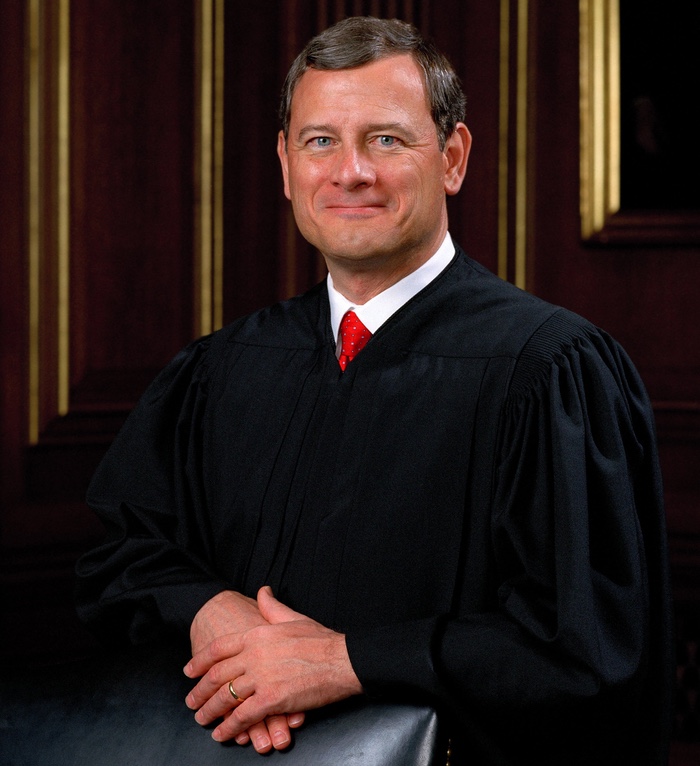
Ohio is known as the mother of Presidents, having sent eight of her native sons to the White House. But she has also been prolific in sending her son (not yet any daughters) to the United States Supreme Court. Of the 116 Justices who have served on the Supreme Court, 22 were nominated by Ohio Presidents.
Of the 17 Chief Justices of the United States, three have been from Ohio: Salmon P. Chase (1864-1873); Morrison R. Waite (1874-1888), nominated by Ohioan U.S. Grant, and former President William Howard Taft (1921-1930) nominated by Ohioan Warren G. Harding.
President Grant also nominated former Secretary of War Edwin M. Stanton, a native of Steubenville, Ohio to the Supreme Court in 1869. However, Stanton died before he was able to take office.
Two Associate Justices of the Supreme Court, John Hessin Clarke (1916-1922) and Harold H. Burton (1945-1958), were from Cleveland. Associate Justice Antonin Scalia began his legal career at the Cleveland Law Firm of Jones, Day, Reavis and Pogue and worked there from 1961-1967. The last Ohioan to serve on the Supreme Court was Associate Justice Potter Stewart (1958-1981), who hailed from Cincinnati.
When Chase was appointed Chief Justice by President Lincoln, a minor controversy arose. Ohioan Noah Swayne (1862- 1881) was already on the court. There had never been two justices from the same state on the Supreme Court at the same time.
In years past, Presidents used various political and ideological criteria in making their selections for the high court and sometimes factored in geographic diversity. Gender, religious and sexual diversity have only been a consideration during the late 20th century. There were uproars from certain segments of the community when Louis Brandeis became the first Jewish member of the Court in 1916, just as there was when Thurgood Marshall joined the court in 1967 and Sandra Day O’Conner in 1981—breaking the tradition of all white men.
Today’s court and the selection process is the topic of Lisa Graves’ new book, Without Precedent – How Chief Justice Roberts and His Accomplices Rewrote the Constitution and Dismantled Our Rights (Bold Type Books, 2025). Graves has been a senior advisor in all three branches of the federal government and was the former chief counsel for the Senate Judiciary Committee, chaired by former Senator Patrick Leahy (D-Vt).
Her thesis is simple, and she states it in the first paragraph of the book: conservative big money interests and a long-term strategy by conservative Republicans, mainly engineered by the Federalist Society, have shaped the Supreme Court and other federal courts since 1991 to their own likenesses and imposed their conservative ideologies on the rest of the nation.
She makes it clear that, in her opinion the current Chief Justice, John Roberts, who took office in 2005 under the presidency of George W. Bush, is a wolf in sheep’s clothing hiding his true conservative and right-wing colors as he advanced his career. She asserts that the current court has become a bastion of radical conservatives, led by Roberts. She cites numerous cases where the court has changed the law of the land, ignored precedence and failed to rely on stare decisis — the principle that courts should follow their earlier decisions to ensure consistency, stability and predictability of law.
Graves demonstrates that a seat on the Supreme Court under Republican presidents for the last several decades comes by virtue of membership in and approval of the Federalist Society, a 43-year-old organization founded at Yale Law School that challenges liberal ideologies in American law schools. The thinking of the members of the Federalist Society is somewhere to the right of Attila the Hun — conservative through and through. On the current court, five of its members are current or former members of the Federalist Society: Brett Kavanaugh, Neil Gorsuch, Clarence Thomas, Samuel Alito and Amy Coney Barrett.
Graves goes chapter by chapter demonstrating how the current Supreme Court has reversed prior ruling that granted broader rights to criminal defendants, women, people engaged in civil rights litigation, and in voting rights cases.
For those who do not understand the court’s path to overturing a woman’s rights to choose in the landmark case of Roe v. Wade, Graves gives a good explanation.
Graves makes no bones about her dislike — more like distain _ for Associate Justices Clarence Thomas and Samuel Alito, whom she considers the most corrupt justices ever to sit on the Supreme Court. She gives numerous examples of unreported gifts, free travel and significant fees for speaking engagement that they received, amounting to hundreds of thousands of dollars. Yet they refuse to recuse themselves when cases arise involving their benefactors. Ginni Thomas, the wife of Justice Clarence Thomas, is a particular target of disdain.
Graves shows how recent court appointees, Amy Coney Barrett, Neil Gorsuch and Brett Kavanaugh, positioned themselves, with the help of the Federalists Society, for seats on the court, by working in the Bush White House and for Republican causes and how they carefully framed their answers to questions in confirmation hearings to hide their true beliefs.
The chapter on Roberts’ court easing restrictions on gun laws is particularly disturbing. In the mind of the Roberts Court, the gun lobby has a free license. There are no gun restrictions, no matter how reasonable, that the Court will not strike down. It’s like the United States Supreme Court has been bought and paid for by the National Rifle Association.
The bottom line is the Republican Party for the last 30 years has engaged in long-range planning in terms of positioning candidates to fill seats on the Supreme Court. They had a farm team. Democrats did not.
Ruth Bader Ginsburg, as great as she was, stayed at the party too long. Had she stepped down during the Obama administration, Democrats could have retained the seat.
With the Republican control of the Senate, the Darth Vater of American politics, Mitch McConnell, was able to block the appoint of President Obama’s appointment of Merrick Garland to the Supreme Court because he said the appointment was too close to the presidential election. But he was able to push through the confirmation of Amy Coney Barrett at lightning speed time just weeks ahead of a presidential election
Elections have consequences and one of the consequences of the Republican dominance of the White House and the Congress is that the Supreme Court has become a rubber stamp, a conservative bulwark that is seeking to overturn everything that Franklin Roosevelt did in the New Deal, every right that was gained during the Civil Rights era, everything that has been gained my women, and every liberal decision made by the Supreme Court in the last fifty years.
If you are already depressed about the future of America, this is not the book for you. In fact, after reading it, I understand the people who don’t watch the news and don’t want to know what’s going on.
The subtitle of this book is how Roberts and his accomplices “rewrote” the Constitution. The title should be how the Supreme is “rewriting” the Constitution. They have only just begun.
`

C. Ellen Connally is a retired judge of the Cleveland Municipal Court. From 2010 to 2014 she served as the President of the Cuyahoga County Council. An avid reader and student of American history, she is a former member of the Board of the Ohio History Connection, and past president of the Cleveland Civil War Round Table, and is currently vice president of the Cuyahoga County Soldiers and Sailors Monument Commission. She holds degrees from BGSU, CSU and is all but dissertation for a PhD from the University of Akron.
One Response to “BOOK REVIEW: “Without Precedent” by Lisa Graves, Reviewed by C. Ellen Connally”
Mel Maurer
Thanks Ellen. We don’t pay enough attention to the Supreme Court and how the Justices get there.