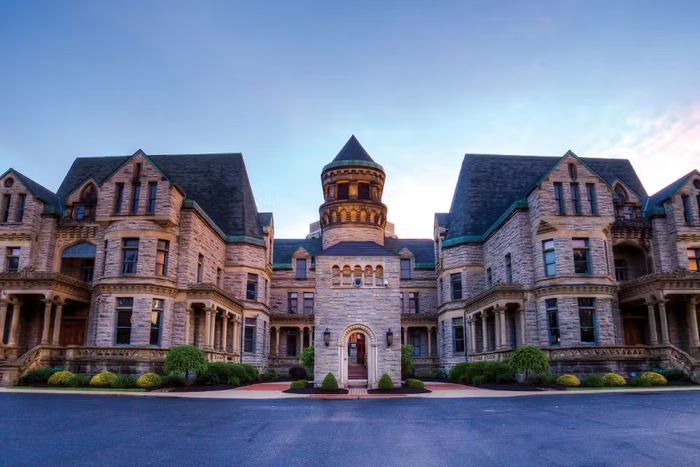
The first time I heard the name The Shawshank Redemption was in 1994. I was driving to work and there was a story on National Public Radio about the forthcoming movie. For some reason — maybe it was the fact that Morgan Freeman was starring in the movie — it stuck in my mind. When the movie came to the Cedar Lee Theater, I was one of the first people to see it. That began my love affair with the movie, the characters and the Mansfield Reformatory.
Since then, I have seen the movie at least once a year. I read the short story — originally titled Rita Hayworth and Shawshank Redemption — by Stephen King from which the movie was adapted. But it took me until last week to finally make the trek to Mansfield, Ohio to the Mansfield Reformatory.
The reformatory was designed by Cleveland native and Civil War veteran Levi Scofield (1842-1917), whose last name was originally Schofield. Schofield also designed the Soldiers and Sailors Monument on Public Square, the Schofield Building at Ninth and Euclid, and several other public buildings around the state, including a Civil War monument on the grounds of the State Capital Building in Columbus.
Buried in Lakeview Cemetery, Scofield’s tomb was the temporary resting place for President James A. Garfield, who was assassinated in 1881. Garfield’s body remained there until his monument was dedicated in 1890.
In the mid 1880s, the State of Ohio decided that it needed to build a facility that would house youthful offenders who had committed minor offenses and were too old for juvenile corrections facilities. Mixing these offenders with older and more hardened inmates at the State Penitentiary in Columbus had proved to be counterproductive to rehabilitation. The aim of the new facility, called the Ohio State Reformatory, or the Mansfield Reformatory, was the rehabilitation of inmates through religion, education and the learning of a trade. In its early years, the model was very successful and there was a low rate of recidivism.
The construction of the Victorian Gothic, Richardson Romanesque, Queen Ann-designed structure began in 1886 and was not completed until 1910 — with the final years of construction being completed by the inmates.
However, as years passed, there were additions to the facility. As Ohio’s prison population grew, the state converted what was designed as a reformatory into a maximum-security facility, a purpose for which it was never intended. In 1990, after inmates filed a lawsuit, a federal court ordered the institution closed due to overcrowding and inhumane conditions.
By the early 1990s the facility was abandoned and fell into disrepair. That’s when the Ohio State Reformatory Preservation Society, a nonprofit overseen by a volunteer board, obtained the building from the State of Ohio for $1. After restoration, which is still in progress, the association maintains the facility for tours. They average more than 120,000 visitors a year. The day of my visit there were visitors from several states outside of Ohio.
The striking architecture of the facility, which comes as a surprise when you pull off the access road leading to the facility, has great appeal for film makers. In addition to The Shawshank Redemption, it has been used in other films including Harry and Walter Go to New York, Tango and Cash, Air Force One, Escape Plan, The Extractors and Judas and the Black Messiah.
While The Shawshank Redemption was not as successful as anticipated when released, it became the most rented video of 1995 and its popularity continues through re-runs, streaming and its frequent airing on Turner Classic Movies. It’s hard to find any adult who has not seen it.
Telling the tales of the unlikely friendship between Andy Dufresne, played by Tim Robbins, the banker who is convicted of killing his wife and her lover, and Red, played by Morgan Freeman, the prison fixer, the man who can get things done, the movie tells not only the story of life behind bars of but of friendship, hope and survival.
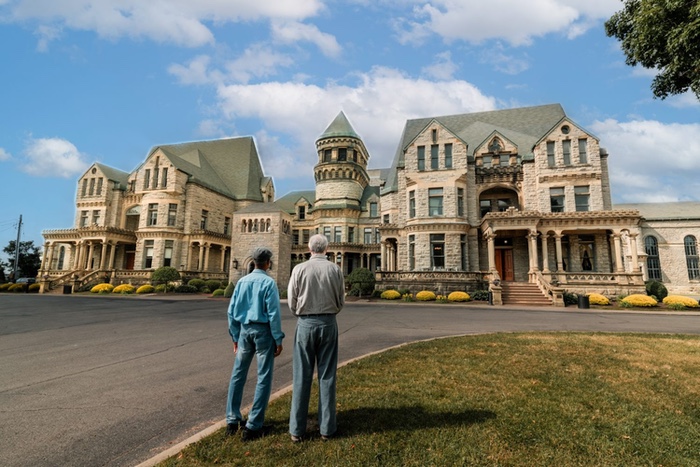
I took the Hollywood Meets History Tour, which is a guided tour lasting about two hours. It was an overview of the facility and the making of the movie. There are also self-guided tours, a ghost tour around Halloween, and a specialized tour on the history of the electric chair in Ohio, aptly named “Old Sparkie.” The chair is on display on the tour.
The trip from Cleveland is a short one hour down I-71. Parking is free and the Preservation Society provided numerous photo opportunities, along with a comprehensive history of the facility and the making of the movie, along with lots of displays of artifacts associated with the movie.
Although the cells in the reformatory were not used in the making of the movie — the studio recreated the cells in a nearby warehouse — you can imagine Red and Andy as they spent their time behind bars as you walk through the abandoned cell blocks. You can sit at the desk of the heartless warden who took his life in the final scenes of the movie. His safe is still in the wall. You can sit in the room where Red has his parole hearings. You can visit the room where Brooks took his life and where Red decided to move on with his life.
If you are looking for a one-day trip in the coming summer months, a visit to the Ohio Reformatory is well worth the time and money. You won’t be sorry, and you will also see the architectural genius of one of Cleveland’s native sons — Levi Scofield.

C. Ellen Connally is a retired judge of the Cleveland Municipal Court. From 2010 to 2014 she served as the President of the Cuyahoga County Council. An avid reader and student of American history, she is a former member of the Board of the Ohio History Connection, and past president of the Cleveland Civil War Round Table, and is currently vice president of the Cuyahoga County Soldiers and Sailors Monument Commission. She holds degrees from BGSU, CSU and is all but dissertation for a PhD from the University of Akron.