
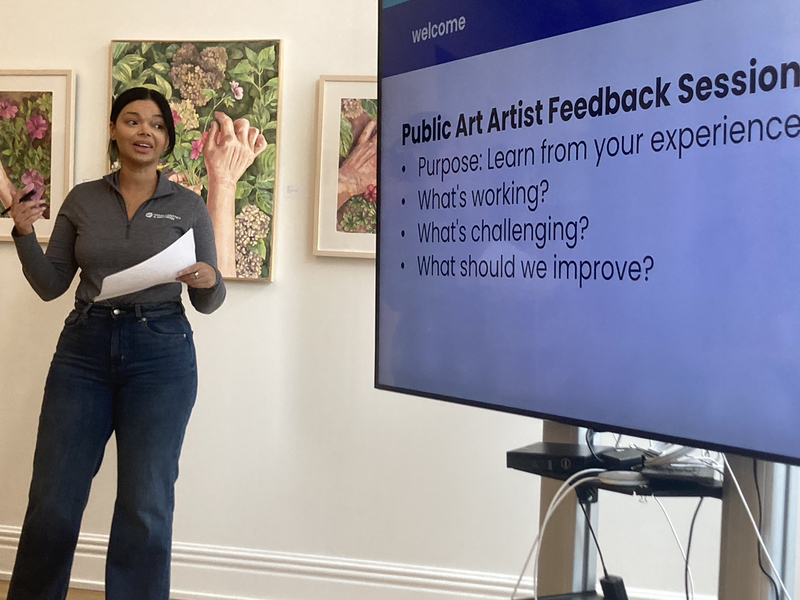
On Saturday, June 27, 2026, a group of artists was invited to a feedback session with City of Cleveland officials to offer recommendations to enhance and strengthen the public art process. Daisha Olmeda, Manager, Innovation & Process Improvement, Urban Analytics & Innovation (Urban AI) for the City of Cleveland, partnered with the Department of City Planning and the Mayor’s Office to gather feedback from artists and other stakeholders to help inform potential improvements to public art policies, processes, and future legislation.
Olmeda admitted it was her first public meeting in her role as Manager of Urban AI. She had no connection to the arts or cultural community and said she was chosen to lead the workshop by the City of Cleveland’s Chief Arts Strategist Rhonda Brown following a meeting last October. Her expertise was in managing websites, she explained.
Olmeda is responsible for streamlining municipal services, improving the operational efficiency of city departments, and eliminating waste, according to the City of Cleveland website. Urban AI designs, maps and analyzes workflows to modernize City Hall operations and builds Key Performance Indicators (KPIs) to make city services more efficient and accountable.
Artists were invited by email, but it remains unclear who made the invitations and why some artists were invited while others were not. Rhonda Brown reportedly requested the meeting. The invitation expressed gratitude for “helping us better understand the artist experience and shape a more effective, transparent and supportive public art process for Cleveland.” Brown would not be there, it said.
The feedback session was described as “a conversation where you can speak openly about what’s working, what’s confusing, and what could be improved. City leadership will not be in the room.”
Inside the LAND Studio offices on Detroit Avenue, where the meeting took place early on a Saturday morning, several tables with chairs faced a large screen near the front of the room. Plastic rainbow-colored slinky toys, along with Post-It pads, pens and fidget spinner gadgets, were scattered on the tables.
Olmeda introduced herself, then went around the room while the others introduced themselves. There were over a dozen artists and activists on hand, plus Jeremy Johnson, president and CEO of Assembly for the Arts, and Erin Guido, director of arts and special projects at LAND studio.
“Rhonda Brown approached us and said we need to look at the public art process,” she said. “If you feel comfortable sharing out loud, we will take notes and bring that back to leadership.”
Fifteen minutes into the presentation, Mr. Soul, an accomplished multidisciplinary graphic and fine artist and public muralist, asked whether any artists had been invited to an earlier meeting, which led to the feedback session.
“No,” said Olmeda. “Rhonda said she wanted to hear from the artists who work with us or who want to work with us.”
Mr. Soul interrupted her. “That is part of the problem. You are making too many decisions for artists, telling us what to do, without having artists as part of the process. That is the ultimate problem.”
Olmeda continued with her presentation. David Biro, a Cleveland artist and founder of the Midnight Art Club, explained the administrative process that artists navigate to complete a public art project in the city. Longtime muralist artist Bob Peck echoed concerns raised by Biro that the process is administratively redundant and achingly slow, with timeline obstructions, adding, “If one [City] department drops the ball and decides not to answer you for a few weeks, it sets your whole schedule back months.”
Ron Shelton, a multimedia and environmental artist known for creating large-scale sculptures out of discarded, recyclable plastics, asked Olmeda to look around the room. “Where is Rhonda Brown? You do not have even three percent of the art community here. There is a problem with that.”
Olmeda promised to take his observations back to City leadership. Shelton got up and walked out of the meeting.
Mr. Soul said he was tired of writing on Post-It notes and tacking them to the wall. “I have been doing that for ten years. I was having the same conversation when I moved back to Cleveland a decade ago. The arts community will never respect Rhonda Brown until she is in these rooms with us.”
Olmeda empathized, she said, before stepping back to listen.
Daniel Levin, a tenured professor at Cuyahoga Community College (Tri-C), photographer, curator and conceptual artist, said Brown should be in the room with Olmeda. “There is no better place for her to be than here today, and Brown not being here makes this presentation feel performative. What was Rhonda thinking? It was not important for her to attend?” added Levin. “It looks really bad.”
Liz Maugans, an ardent, vocal activist in the arts, artist, and full-time faculty member at Cleveland State University, said Brown was hired to create a cultural plan, and to date, there is none. “It is distrust and arrogance on her part, together with no updates or clear communication, including whether this meeting will be communicated to her clearly,” she said. “We want ourselves and the next generation to work through these issues fluidly.”
Maugans cited the Transformative Art Fund (TAF) project as an example of stonewalling communication attempts between the City and the public, which has led to confusion and frustration in the community. “There is pushback from the City when public records requests are made. We still do not have them. There is no accountability or publicity for TAF. What a disservice to the artists who received these awards,” she said.
CoolCleveland has repeatedly contacted Brown for an interview without success. Other local media outlets have also tried unsuccessfully to communicate with City leadership. Public records requests have been unresponsive. Attempts to interview Brown have been thwarted by Brown and Tyler Sinclair, communications strategist for the City of Cleveland.
In a yet-to-be-published interview with CoolCleveland, Robin Robinson, the only one of seven TAF lead artists to respond to a CoolCleveland media request, said she has “absolutely no idea” why the public records surrounding the TAF project have not been made available to the media. “The records were released to Rhonda Brown,” she said. “She has the records.”
Forty minutes into the three-hour meeting, tensions were high. Levin read a description of Brown’s position from the City’s website. “Primary liaison between city leadership, philanthropic funders, education supporters, and the local creative community,” he said. “Does Rhonda feel in her job description that she has to be communicative with the art community? Ask her that question. Does she feel the need to have an invisible wall between her and the art community? Because that is how it feels. She works for us; remind her of that.”
Over an hour later, fatigue set in. The conversation circled around the abrupt disconnect between the chief arts strategist and meaningful relationships with the creative community.
Mr. Soul added to the criticism of Brown, suggesting that a public outpouring of lack of confidence in her is needed to create positive and lasting change. “I say we advocate to get her out of here and make it more public,” he said.
Maugans asked whether the results of the meeting would be made public at a later date to inform the community and understand the purpose of the feedback session with the City.
“As manager of innovation and process improvement, I cannot release any public information,” replied Olmeda.
The room broke out in laughter before dispersing into the street.
Bruce Checefsky is a filmmaker, photographer, and published writer. He is the recipient of three Ohio Arts Council Individual Excellence Awards, a Creative Workforce Fellowship, and four CEC ArtsLink Fellowships.