I have been feeling a little shake-up happening in the cultural landscape here on the North Coast lately. I’ve been trying to separate the layers of political, public, philanthropic and economic pressures that seem to be colliding all at once. It feels a bit like playing Whac-A-Mole, and it made me wonder whether others are feeling it too.
For decades, growth and sustainability were the dominant strategies for creatives, artist-run galleries and institutions, both large and small. Around 2000, Cleveland began building arts districts. The Cleveland Foundation, known as the world’s first and largest community foundation, turned 100 and continued to support new global residencies and other initiatives through its funding. Nonprofits multiplied. Festivals emerged in nearly every neighborhood. Galleries opened. Community arts programs expanded. Makerspaces exploded.
Public-sector cigarette tax revenues flowed in like crack, and the prevailing assumption was that more art, more organizations and more programming would naturally create larger audiences and attract newcomers to our cultural bounty from outside the region.
The sheer volume of cultural offerings also exploded. On any given weekend, cultural consumers can choose from hundreds of events, exhibitions, festivals, concerts, online experiences and entertainment options. The competition is no longer simply among arts organizations—it is among every possible way a person can spend their limited time and attention.
Tastes and delivery systems have changed. The nostalgia-driven visual arts scene of the 1970s, ’80s, and ‘90s is gone. Social media dominates and saturates the brainwaves of our already distracted audiences. The packed Friday night gallery openings, artist talks, neighborhood walks and nationally supported residencies have dwindled—some fading altogether. It’s kinda like those faded Jordache jeans we held onto—they just don’t fit anymore.
Thankfully, we still see the loyalists, mostly in their 50s and 60s, faithfully art-hopping. But it has been difficult not to notice how few younger people are curating, leading organizations, serving on boards, or opening artist-run spaces of their own. Cleveland is approaching a tipping point as a generation of veteran arts leaders step away, many eager to return to their studios to focus on their own art practice (me included).
This creates a cultural cliff: a point where the supply of arts programming exceeds the capacity of audiences, donors, volunteers and institutions that used to be able to sustain it.
For decades, the city has punched far above its weight culturally. It boasts world-class institutions, neighborhood arts organizations, artist-run spaces, festivals, public art initiatives, and a remarkably active creative community. Much of this infrastructure was built through the vision and persistence of leaders who often remained in their roles for 20, 30 or even 40 years.
Today, arts organizations continue to grapple with declining attendance, changing audience behaviors, rising operational costs, and increased competition for philanthropic dollars.
There are certainly success stories. Community makerspaces such as Zygote Press, Praxis Fiber Workshop, Cleveland Print Room, Morgan Conservatory and Shed Projects have remained deeply rooted in neighborhoods. Many have invested in permanent spaces and cultivated audiences that are truly intergenerational—high school students who are not college-bound, recent BFA and MFA graduates, mid-career creatives, and retirees returning to a lifelong love of making art. They have become places where people gather, learn, make and belong. That is the good news.
Yet many institutions find themselves caught between ambitious programming schedules and shrinking capacities. Often, artist talks are fortunate if they have ten people attending. Cleveland audiences are consuming culture differently than they did 20 years ago. Younger generations often seek experiences rather than memberships. They are less likely to purchase art for their walls, join boards, subscribe to season tickets, or make annual donations at levels previous generations considered civic responsibilities. Through no fault of their own, many are understandably cautious about their quality of life, financial stability and future prospects.
I have played a game with a few friends who tolerate my crass sense of humor. It’s similar to the old Fuck-Kill-Marry game. (This is a game where you name three people of notoriety and you have to pick who you are going to Fuck-Kill-Marry) Instead, pick any Northeast Ohio visual arts organization, artist-run space, nonprofit or museum, and assign one of three words instead: Pivot. Reset. Sunset.
The exercise is meant to be provocative, but increasingly it feels less hypothetical.
Many longtime leaders are retiring, and a surprising number of younger visionary leaders are responding with a polite, “No, thanks.”
Executive directors, founders, curators, department chairs and long-serving arts administrators are stepping away, leaving behind organizations shaped by decades of relationships, institutional knowledge and personal commitment. Their departures create both opportunity and uncertainty.
The question is not whether younger leaders are talented. They are.
The question is whether they are being asked to inherit systems designed for a world that no longer exists.
Many emerging leaders enter positions facing challenges their predecessors never encountered: escalating facility costs, fragmented audiences, digital disruption, stagnant public funding, donor fatigue and increasing demands around accessibility, inclusion, community engagement and impact measurement. They are expected to innovate while simultaneously preserving institutions built under entirely different economic conditions.
Adding to the challenge is the fact that many younger cultural workers are already stretched thin. They carry significant student debt, face difficult housing markets, and often work multiple jobs simply to remain in the sector.
Passion remains abundant. Capacity does not.
The arts sector may need to confront difficult questions about sustainability. Do we need every organization, every festival, every annual event that currently exists? Can collaboration replace competition in some areas? Should success be measured by growth or by resilience? Are there healthier ways to share resources, facilities, staffing and audiences?
These conversations can feel threatening because they challenge assumptions many of us have held for decades. Yet the future of Cleveland’s cultural landscape will not be determined solely by funding levels or audience numbers. It will depend on whether the sector can honestly assess its current realities and adapt accordingly.
Perhaps the next generation’s greatest contribution will not be preserving every existing model because they know new models and innovations need creating.
The arts have always evolved in response to changing conditions. Cleveland’s burning river helped inspire the creation of the Environmental Protection Agency. The city once mocked as the Mistake on the Lake still has the Goodtime II sailing proudly across its waters.
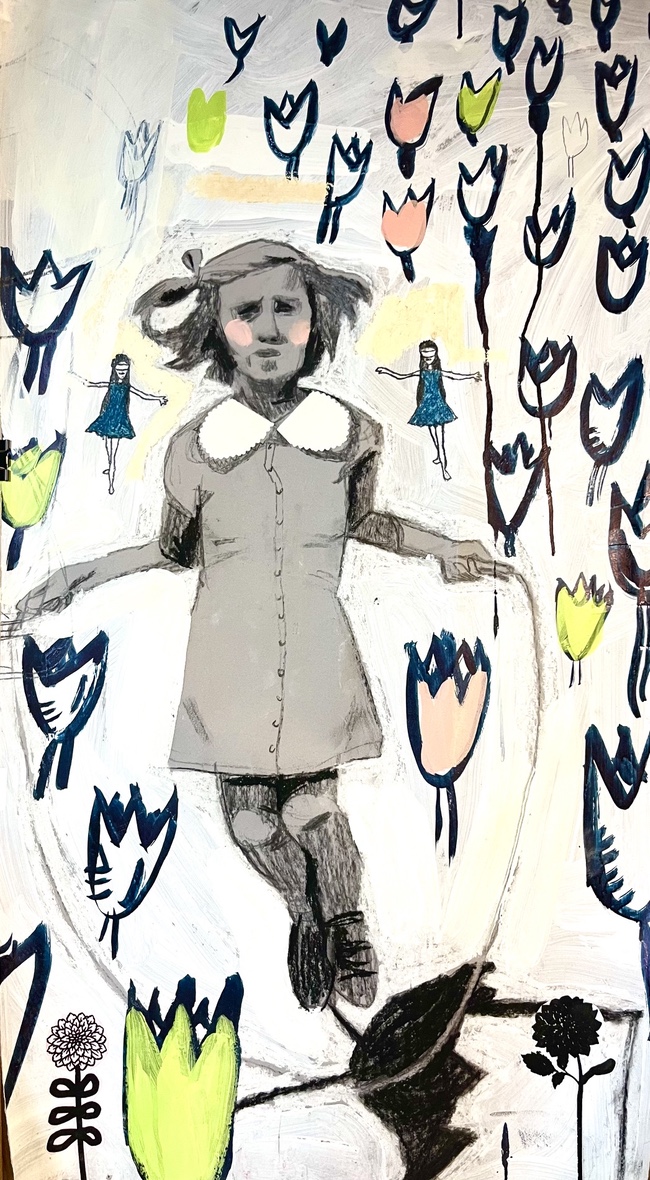
Illustration by Liz Maugans
Liz Maugans is a Cleveland-based artist, mom of three great kids, a social justice advocate, an educator, a gallerist, and curator. Maugans co-founded Zygote Press, the Collective Arts Network, the Cleveland Artist Registry and the Artist Bridge Coalition. Currently, Maugans is Visiting Assistant College Lecturer and Haddad Studio/Art History Career Mentor at Cleveland State University, Department of Art and Design. She is on the Board of the Collective Arts Network and Refresh Collective. Her work is represented by Hedge Gallery at 78th Street Studios. www.lizmaugansart.com