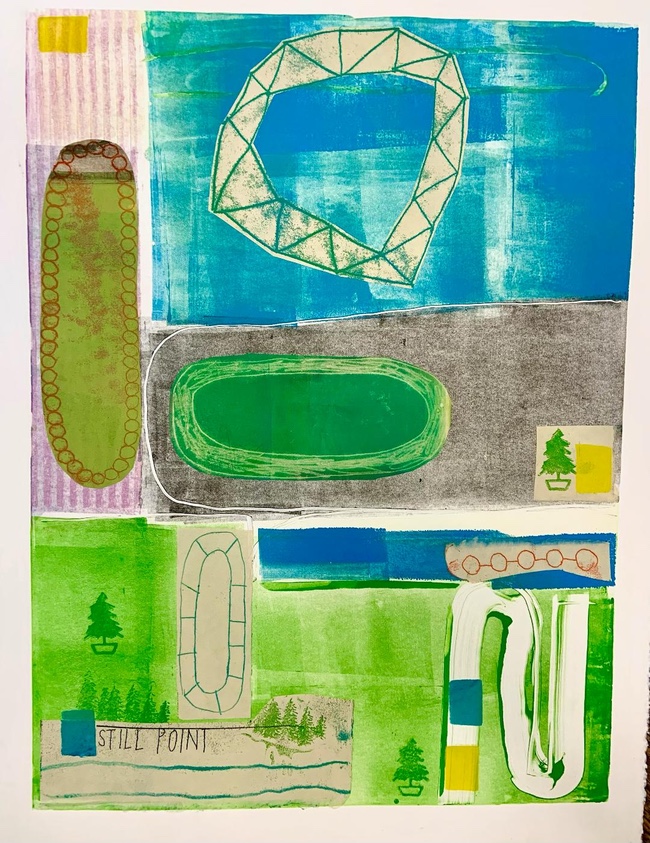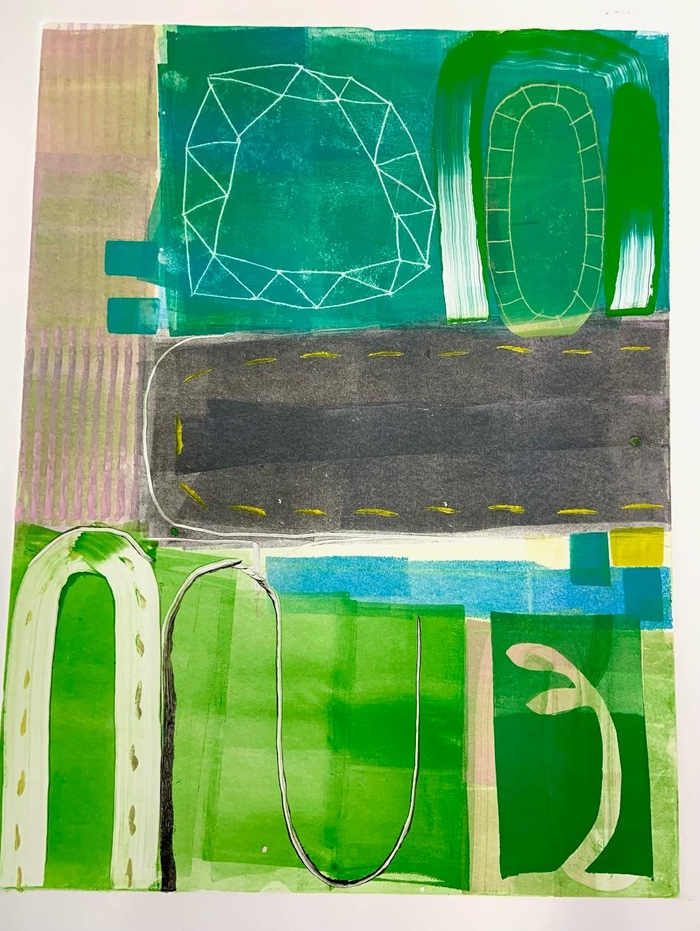
“Two roads diverged in a wood, and I—I took the one less traveled by, And that has made all the difference.”-Robert Frost, “The Road Not Taken”
On Palm Sunday, my Pastor Joanna D’Agostino offered a concept called desire paths that has lingered far beyond the sermon.
I had never heard of this term. It is commonly used in urban development which is where informal trails are worn into the ground by people choosing their own routes—organic, intuitive, human. They appear where sidewalks fail, where official plans overlook lived experience, where the body knows something the blueprint does not.
Desire paths are evidence and reveal how people move through space—how they cut across grass to reach the lake, how they trace shortcuts through parks, how dogs and their humans quietly redraw the map day after day. These paths are not designed. They are felt. Habit trails is another name for them.
And creatives? We are natural makers of desire paths. Artists, writers and cultural workers live in the in-between—close to the street, embedded in the texture of everyday life. We notice the edges, the overlooked, the possible. We move off-road. We operate in the fray, because we are used to being excluded from the very processes that shape the civic terrain we inhabit. Our instincts, affinities and fringe thinking are rarely invited into the official planning of a city.
Instead, paved paths are laid out in advance—prescribed routes determined by those in power are often far removed from the lived realities of the people who actually walk them most. What happens when cities pave before they listen? When imagination is sidelined in favor of pre-determined opportunity corridors and Dead Man’s Curve?
These are patterns, all too often repeated across sectors, particularly the cultural sector:
*History gets rewritten or erased.
*Processes become confusing, opaque.
*Ideas are lost in translation.
*Silence replaces dialogue.
*Questions are ignored, in hopes they fade.
*Disorientation sets in.
*Gatekeepers assume they know best.
*Accountability is deflected or resisted.
*Rules shift to protect authority.
*Responsibility is passed along.
*Records disappear.
*Survival instincts override collaboration.
*Policy becomes secondary to preservation of power.
These phases are not abstract—they are familiar. They are the quiet derailments that block meaningful civic participation.
Meanwhile, the people, the folks on the ground—already know the terrain. They know the routes to the river, the best fishing spots, the shortcuts across neighborhoods. They understand the rhythms of place because they live them. They create the real infrastructure of movement and meaning, even when it goes unrecognized.
So when cities invest in “build it and they will come” approaches, we have to ask: will they? Or have we ignored the very patterns that would guide us? When creatives and communities are excluded, mistrust grows. Participation wanes. Cynicism takes root.
But desire paths offer another way forward because they ask us to observe before imposing. To listen before designing. To recognize that culture is not a top-down construct—because it emerges from collective movement, memory and imagination.
What would it look like to build a People’s Cultural Plan for Cleveland? What if we mapped the city not just through infrastructure, but through lived experience—walking, biking, gathering, making? What if we invited artists and residents to co-create the routes forward, honoring the paths already etched into our shared landscape (and making new ones too)?
A lot of people are really struggling in our world and mistrust is the default. Aren’t the city planners and decisionmakers ready to collaborate with new navigators who can envision this grand city’s landscape here? If they worked as hard on opening the process as they do trying to hold onto their jobs, we could really get somewhere. Desire paths don’t just connect places—they connect people. They reveal where we want to go, together.
Liz Maugans is a Cleveland-based artist, mom of three great kids, a social justice advocate, an educator, a gallerist, and curator. Maugans co-founded Zygote Press, the Collective Arts Network, the Cleveland Artist Registry and the Artist Bridge Coalition. Currently, Maugans is Visiting Assistant College Lecturer and Haddad Studio/Art History Career Mentor at Cleveland State University, Department of Art and Design. She is on the Board of the Collective Arts Network and Refresh Collective. Her work is represented by Hedge Gallery at 78th Street Studios. www.lizmaugansart.com