Books about Nature and caring for the Earth are plentiful. Some, like David Henry Thoreau’s Walden, teach us to appreciate the natural world—the more we love it, the more likely we are to care for it. John Muir’s First Summer in the Sierra started a movement that continues to take on initiatives to save the earth. Barbara Kingsolver’s novel Flight Behavior shows what happens when the monarch butterfly population declines to the point that all symbiotic relationships collapse and the earth experiences floods like Noah dealt with.
It’s easy to get overwhelmed about climate change as we face another hot year. The better way is to find solutions. One suggestion I have is to read more about how nature works, how humans contribute to the current climate crisis, and what experts say we must do. The next step is to take personal action that goes beyond recycling plastic—how about not buying products packed in plastic? Or not buying anything at all?
Braiding Sweetgrass, written by botanist-professor Robin Wall Kimmerer, a Potawatomi woman and college professor, stands out with its emphasis on what plants and animals can teach us about the science of nature. Kimmerer shows her readers how interacting with Nature brings us into a reciprocal relationship where Mother Earth provides for us when we offer our thanks, care and gifts.
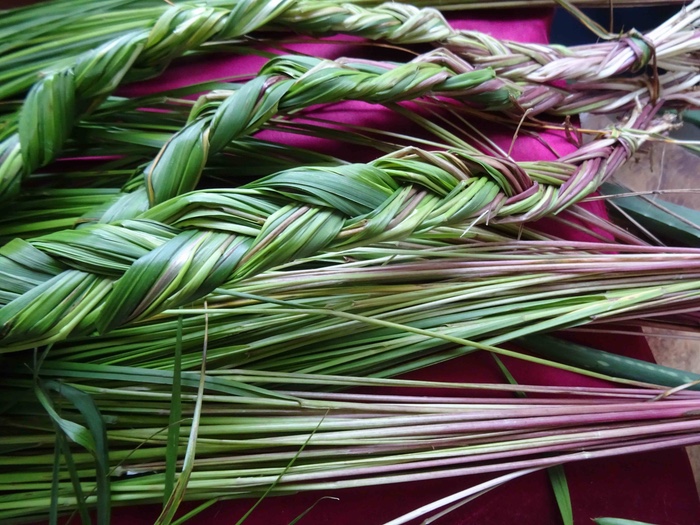
Sweetgrass is an aromatic herb considered sacred by Indigenous peoples in Canada and the United States that is braided into artful baskets. In her book, Kimmerer braids together indigenous ways of knowing, scientific knowledge and her own story as a Potawatomi scientist, which creates a sacred way of being. Sweetgrass is planted by putting roots directly in the ground in a reciprocal relationship between humans and everything else.
The book is made up of a series of story essays that show us how to live in a way that honors the Earth to receive its bounty. When you plant a seed and nourish it with water, soil and sunlight, it grows into a head of lettuce or a carrot because you tend to it. That’s reciprocity. Kimmerer also writes about the spirit of community, a gift economy, gratitude and the four aspects of being—mind, body, emotion, and spirit, among others. It’s a dense poetic book that’s exciting, inspiring and spiritual.
The book begins with the retelling of the Haudenosaunee creation story, in which Skywoman falls to earth and is aided by the animals to create a new land called Turtle Island in the essay “Skywoman Falling.” The world is a place of gifts and generosity from Nature, which requires that we give gifts back. Kimmerer raises questions, as she might do in her college classes. If you truly focus on the Earth that will be left for your grandchildren, how would you live differently? If plants are telling a story, how can we humble ourselves to “listen” to the wisdom of plants?
One of my concerns is how our artificial country borders cause territorial wars, human displacement and uneven distribution of the world’s resources. In “Allegiance to Gratitude” Kimmerer considers the difference between the U.S.A.’s Pledge of Allegiance and the Haudenosaunee Thanksgiving Address. The Thanksgiving Address makes a list of various aspects of the natural world and gives thanks for them all. Kimmerer suggests that we might be better off with such a mindset of gratitude, pledging allegiance to the land itself rather than a flag or nation. Interesting idea. Imagine how a place without borders may mean that human beings would work together for the greater good. Wouldn’t that be lovely?
Sweetgrass is harvested in midsummer when the leaves are long and shiny. The blades are dried in the shade to preserve the color, but first, a gift is always left in return (because it would be rude not to ask). The chapter “Epiphany in the Beans” furthers the theme of reciprocity between humans and the land, as Kimmerer describes the Three Sisters—corn, beans and squash—that are a staple of many Indigenous cultures and are designed to grow together and support each other in a harmonious relationship. When corn, beans and squash are planted together, their organic symmetry belongs together, and there will be enough for all. Kimmerer goes on to suggest that non-Indigenous people treat the land like the home one is responsible to. Maybe I should experiment with planting corn, beans and squash together to watch how they support each other.
Kimmerer lives near New York State’s Onondaga Lake, which was severely polluted because of mankind’s overconsumption. The sacred land “where the Peacemaker walked and the Tree of Peace stood isn’t land at all, but beds of industrial waste sixty feet deep. It sticks to shoes like thick white school paste used in kindergartens to glue cut-out birds onto construction-paper trees.” Rainwater lands on the waste beds and becomes high pH leachate that burns human skin. The lake is being restored, but health is a long way off.
Today, the price of human development can be seen everywhere we look, if we bother to. That’s where to start the healing process—spend time in nature to experience its beauty and be grateful. Let that feeling spur you to get educated in how plants work together to grow better gardens. Know that when a tree’s life ends, the complex network of roots and tree speak is disrupted. Gain an understanding of how animals depend on each other (like cattle egrets and water buffalo) and respect that system by letting it be.
Answers can be found in science, but it is not the only way to understand the world. If people return to the old simpler ways of living and recognize the abundance the earth has given us, they will be encouraged to give back to our blue planet. Human civilization disrupts the earth, but we have the information and ability to heal and reawaken it. There’s hope for the future if we come together.
For further reading, I also suggest Robin’s books Gathering Moss and The Serviceberry. She teaches at the State University of New York, College of Environmental Science and Forestry, in Syracuse. She is also a popular lecturer; find her upcoming events here. I’m noting that she’ll be at The College of Wooster on November 4, 2026 in an event that is open to the public.