
On November 25, 2025, the nation marked the 62nd anniversary of the funeral of President John F. Kennedy. The eyes of the nation and the world were on Washington, D.C. as Americans saw their slain President laid to rest.
On September 26, 1881, the eyes of the nation and the world were focused on Cleveland, for the funeral of another slain president, Ohioan James A. Garfield.
For most of the 20th and 21st Century, the average American knew little or nothing about James A. Garfield. But thanks to the widely acclaimed Netflix movie, Death by Lightning, starring Michael Shannon as Garfield and Mathew Macfadyen as his assassin Charles Guiteau, the second president to die at the hands of an assassin is back in the public eye.
Garfield, who was a member of Congress, became the dark horse candidate for President in 1880, after delivering a stirring address to the Republican convention in support of his fellow Ohioan, Senator John Sherman. When the convention deadlocked, the delegates turned to Garfield, who was not seeking the office. He and his running mate, Chester A. Arthur, went on to defeat Democrat, Winfield Scott Handcock, in the November election.
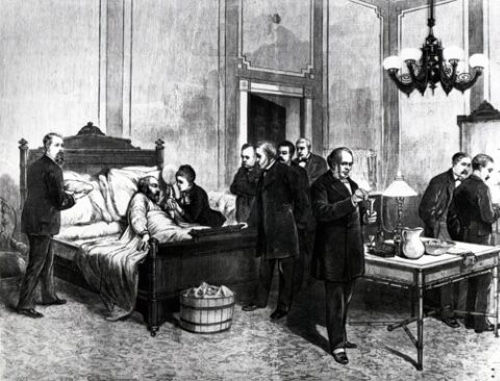
Just 200 days into his presidency, on July 2, 1881, Garfield was shot by Guiteau at a Washington D.C. train station. For the next 80 days he hovered between life and death. On September 19, 1881, he succumbed to his injuries. Across the nation, Americans sat by telegraphs and newspaper offices awaiting news of his condition.
Guiteau — a disgruntled office seeker and a man with mental health issues — fired two shots at Garfield, one causing a minor injury to Garfield’s arm and another to his torso. But the doctors, particularly Dr. Willard Bliss of Mentor, a family friend who attended to the stricken president, did much to insure his death. Bliss continually probed the wound trying to remove the bullet causing additional injury. He refused to follow the advice of doctors who tried to tell him that washing your hands and maintaining a sterile environment saved the lives of patients. As historian Candice Millard points out in her 2011 book, Destiny of the Republic, Garfield died of an infection and complications of probing the wound. By today’s standard he would be the victim of gross medical malpractice.

Visitors to Lakeview Cemetery are aware of Garfield’s final resting place in the impressive monument located on the highest point in the cemetery. Others may have passed by or visited his home in Mentor. However, few are aware of his funeral which was labeled “The Most Impressive Funeral Ever Witnessed” was held right here in Cleveland.
Garfield was born in poverty, in a log cabin in Moreland Hills in 1813. A replica of the cabin stands on SOM Center Road, near the Moreland Hills Police Department. For those interested in presidential trivia, Garfield was the last president born in a log cabin.
He grew up in northeast Ohio; worked on the Erie Canal; attended Williams College; became a lawyer; served as the President of what is now Hiram College; and was ordained a minister in the Disciples of Christ, making him the only ordained minister ever to serve as President of the United States.
After service as a general in the Civil War and serving in the Ohio Legislature, the citizens of Ohio’s 19th Congressional District sent him to Congress in March 1863, where he would serve until November 1880 when he was elected president.
As Garfield lingered between life and death during the long hot summer of 1881, two prominent Clevelanders, industrialist and philanthropist Jeptha Wade and Cleveland Mayor R.R. Herrick, worked to ensure that Cleveland would be the site of his funeral and burial. Wade, the founder and president of Lake View Cemetery, influenced Mrs. Garfield, to bury her husband in his cemetery.
Wade did so, at least in part, to enhance the reputation of the cemetery and encourage sales of lots in the financially troubled institution. Founded in 1869, the cemetery was on the outer edge of the city limits. Since the Euclid streetcar line stopped at University Circle, the cemetery was struggling.
Mayor Herrick sought to have the funeral in Cleveland to enhance the image of the city, understanding that the influx of guests for the funeral would do wonders for the hotel and livery business of the city. Mrs. Garfield, a widow with financial problems and a family to support in an age before presidential pensions, readily accepted the largess of both the city and the cemetery, to the chagrin of residents of Mentor, who voiced their concerns in local newspapers. They wanted Garfield buried in Mentor. Although a frequent visitor to Cleveland, Garfield lived in Mentor and was elected to office by the citizens of Mentor.
The funeral was indeed a grand affair. An elaborate pavilion was erected on the northeast corner of Public Square, like the one erected for the coffin of President Abraham Lincoln.
Described as probably the finest temporary structure of its kind ever erected in America, it was forty-five feet square, with a thirty-foot archway on each side. The pavilion was filled with so many flowers that local supplies were exhausted, and boxcars of flowers were hastily delivered from Cincinnati and Chicago. Buildings were draped in black all along Euclid Avenue, the route of the funeral.
Over 100,000 people passed the casket, and thousands lined the processional route, often several people deep. The funeral procession stretched the length of Euclid Avenue to the cemetery. As the final marchers were leaving Public Square, the beginning of the procession reached Lakeview Cemetery —a distance of some eight miles.
As a result of the late President’s entombment at Lakeview Cemetery, the streetcar line was extended to reach the cemetery. In an era when tourism was just becoming popular among middle and working-class Americans, Cleveland became the site of many pilgrimages to visit the President’s grave.
Wade’s decision to encourage Mrs. Garfield to bury the President in Lakeview paid off. Ultimately Lakeview Cemetery would become the premier burial spot in the area, becoming the final resting place of such notables as John D. Rockefeller, Secretary of State John Hay, Cleveland Mayor and Secretary of War Newton D. Baker, and thousands of other Clevelanders, famous and not so famous.
Historians can only speculate as to how a Garfield presidency would have changed history. His death caused the ascendency to Chester A. Arthur to the presidency, who was not as bad as he is portrayed in the current Netflix movie. He was instrumental in initiating reforms to the spoils system and creating civil service reforms that ensure the security of government jobs that exist in some form until today.
As for Guiteau, he was tried in the District of Columbia court. His was the first high-profile case in the United States where a defense based on a claim of temporary insanity was considered. The jury did not buy Guiteau’s defense, finding him guilty as charged. He was executed by hanging on June 30, 1882, two days short of the anniversary of his crime.
Pieces of the rope that hung him were eventually sold as souvenirs. His skull and parts of his brain are on display at the National Museum of Health and Medicine in Silver Springs, Maryland. The gun that Guiteau purchased to kill the president, which he selected because of its pearl handle which he felt would look better in a museum, was lost after the trial, and to date has never been located.
For further information on President Garfield and local events see The Garfield Trail, a website dedicated to keeping his memory alive.
For information about Garfield’s Mentor home see nps.gov/jaga/index.htm.

C. Ellen Connally is a retired judge of the Cleveland Municipal Court. From 2010 to 2014 she served as the President of the Cuyahoga County Council. An avid reader and student of American history, she is a former member of the Board of the Ohio History Connection, and past president of the Cleveland Civil War Round Table, and is currently vice president of the Cuyahoga County Soldiers and Sailors Monument Commission. She holds degrees from BGSU, CSU and is all but dissertation for a PhD from the University of Akron.
3 Responses to “The Cleveland Funeral of President James A. Garfield by C. Ellen Connally”
Mel Maurer
Very interesting. The program you reference is very well done. I think his Mentor house and his monument will be getting a lot of new visitors.
Peter Lawson Jones
Absolutely fascinating, Judge Connally. You continue to prove your bona fides as a most astute history scholar. “Death by Lightning” is next in my queue of television series that I intend to watch. Happy Thanksgiving.
Soap Andre
Wow, I really appreciated your article Judge Connolly on the history of President James Garfield. I will be looking forward to seeing his childhood home and exploring his memorial in honor of him at Lakeview Cemetery. Thank you for sharing this information. Respectfully, Diane Andre