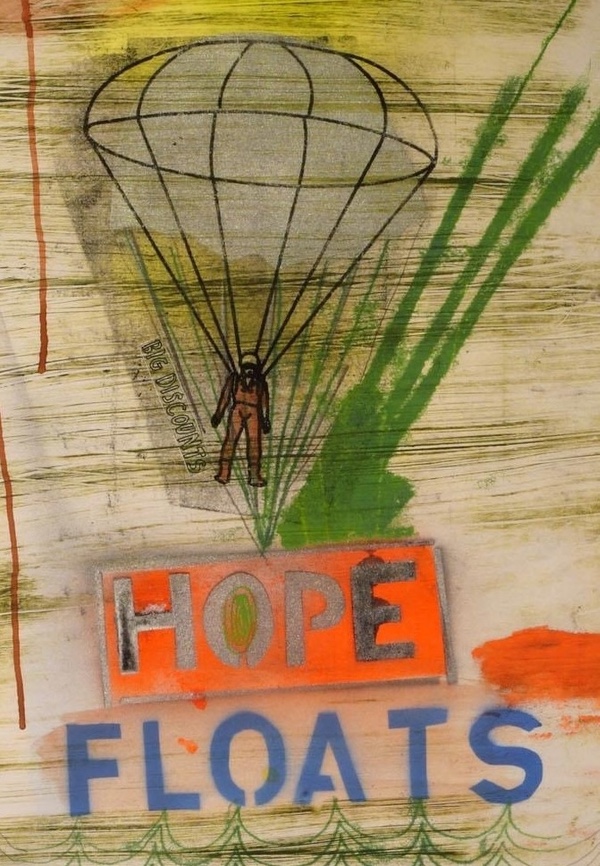
We are living in an era of franticness, fear and fragmentation.
In this chaos, creatives are reaching inward and outward — trying to understand how their talents, vision, and soulfulness can not only express what’s happening, but disrupt it — while staying healthy.
Countless creatives have asked me “How can I do something in this noise?” “How can I stay connected — to others and to myself — while all these systems unravel?”
Our region’s cultural history — marked by resistance, reinvention and grassroots imagination — has been a vital source of inspiration revealed countless times. Collective creativity has always been a form of care, connection and clarity. From warehouse galleries (Art Without Walls, Summit Artspace) to front-porch concerts (Larchmere Porchfest, Highland Square’s Porchrokr), to cultural street events (Akron Pride, Hessler Street Fair), this city reminds us: when institutions fail, we make our own stages, our own salons and our own movements.
In a world spinning with uncertainty, artists — like astronauts — must learn to adapt, lead and sustain themselves and their communities on long, often uncharted journeys.
Creatives need clear and constant dialogue where they speak honestly and with intention — in their work and with each other. Listening to each other is as important as broadcasting who we are as a cultural community. Our practice, beyond the self-serving, capitalist agenda, needs nurturing from transparent collaboration, reflective critique, with community accountability at the center.
All too often, creatives are used as collateral by cultural bureaucrats who invite us to the table only when our presence serves someone else’s metrics. Our relevance, we’re told, lies in how well we perform as engines of the “creative economy.”
We are asked to speak the language of ROI, of abundance, of entrepreneurialism — to convince politicians, funders and powerbrokers at the city or statehouse that we matter. That our art has value because it can be sold, branded or leveraged. But this isn’t the full story. It isn’t even our story.
The word “economy” comes from the Greek oikonomia — meaning housekeeping. And what is art if not a form of housekeeping? We tend to grief. We make spaces for joy. We repair memory. We preserve culture. We hold the contradictions. We sweep the corners clean of forgetting.
There are many forms of housekeeping — emotional, spiritual, communal — that go unseen and unpaid, but they are no less vital. They are the very foundation of what makes a city livable, a culture rich, a people whole. So yes — our work circulates in economies. But more importantly, it builds homes for imagination, connection, resistance and rest.
The origins of creative workers was always a grassroots effort. Much like home births, which were once the standard and sacred method for bringing life into the world, the work of creatives has long existed outside of institutions — rooted in community, ritual, necessity and shared knowledge.
But somewhere along the way, we were told that only the hospital was safe. That only the gallery was legitimate. That only the academy could confer value.
And so we internalized those norms — set by institutions, art schools and bureaucracies — believing they were natural, neutral or deserved. We learned to speak in artist statements, grant language, critique jargon. We tried to make ourselves legible to systems that were never built with us in mind.
But just as midwives never stopped catching babies, artists never stopped making work that mattered, outside of official structures. In kitchens. In garages. On the street. In church basements. In bedrooms. In zines. In exile. In joy.
It’s time we remember that the dominant model is not the only model. It never was. And maybe, just maybe, it’s time to come home. To reclaim the knowledge we already carry. To honor the uncredentialed, the uncounted, the deeply known. Creatives are not here to be used. We are here to transform.
Back to space, where the astronauts need to have self-care and emotional resilience as a necessary means to survive. They need to pack their oxygen for their journey ahead. Creatives must tend to their needs or it threatens our own survival. Artists must also replenish — not as luxury, but as necessity. Rest as resistance, setting boundaries as creative fuel and finding nourishment (mental, physical, spiritual) as part of the artistic process.
No astronaut makes it alone. Expeditionary artists look out for one another — across disciplines, egos and pressures. Grassroots movements naturally build artist pods and provide peer support, shared meals, exchange of individual support as we have met all over Cleveland at galleries, community spaces and beyond. Grassroots movements practice mutual aid: resource sharing, co-mentorship, collaboration and resisting competition — vying for celebrating the win of any member as a win for everyone.
This leads to an atmosphere of “cooperation over competition” where the mission in front of the collective comes first. The old model said, “compete for space.” The new one says make space — for more voices, more risk, more imagination. It is here that the grassroots de-centers scarcity, values process as much as product, and chooses collective liberation over individual validation.
Finally, grassroots creative energy redefines the mission and, like astronauts, creatives often return changed — knowing our planet more intimately because they left it. Artists too can return from the edge with new truths and tools for the world. The standard mission might not be recognition — it might be repair. It might not be gallery representation — but grassroots reimagination.
Not escape — but embodiment.
2 Responses to “CULTURATI: Re-Birthing Grassroots Thinking in the Creative Cosmos by Liz Maugans”
Stephen Calhoun
This is great Liz. Especially: “Expeditionary artists look out for one another — across disciplines, egos and pressures.” and, “The standard mission might not be recognition — it might be repair. It might not be gallery representation — but grassroots reimagination.”
We already know we’re in alignment. One field of regard I’d add orbits the crucial concept: artists able to take themselves very seriously. By this I mean how artists contextualize and socialize and network their intentions, their understanding of communication and exchange. . .and much more.
Our local art world has almost no PUBLIC critical capacity whatsoever. Critical capacity requires lively dialogues across creative communities. Apparently it is up to serious artists to create the weave of regard; experience; diligent thoughtfulness and critical comprehension.
This also necessarily, comes to include social critique and interrogation of the institutional norms.
Maybe QUEST4theFEST could convene an intervention built on serious social appraisal and inclusion.
Liz Maugans
Stephen- these are all great reflections. It can move from a conceptual frame to an active one! It’s my dream as you know!