Fri 6/26 – Sat 7/18
West Tremont’s convergence-continuum theater continues to break down the fourth wall in its pursuit of expanding the Northeast Ohio theater experience. Basically, the idea is to take the audience member out of their comfort zone.
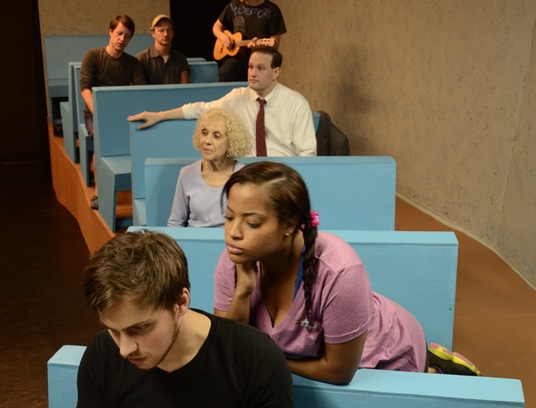
Such re-imagining of the conventional boundaries of language, structure, space and performance drive the company’s upcoming production of Liz Duffy Adams’ The Reckless Ruthless Charge of It, or THE TRAIN PLAY, which opes 6/26 and runs Thu-Sat through 7/18 at the convergence-continuum space known as The Liminis.
In a nutshell, the young playwright’s work, which debuted in 2012, takes place somewhere in America on a train where eight strangers are bottled up having a discussion about life and death. CoolCleveland talked to convergence-continuum’s artistic director Clyde Simon, who is directing THE TRAIN PLAY.
First of all, what was it about THE TRAIN PLAY that piqued your interest?
It’s by a kind of a hot young playwright, which is the kind of thing we like to do, but really it’s the play itself, of course. It’s an ensemble piece, and it’s just crazy in a good way. We’re only the fourth production of it ever. It’s the kind of non-realism that we like. It’s almost surreal and the language is really interesting. The crazy part — but the basic idea — is that these strangers on a train are all going through individual crises sort of in their lives. Existential type of crises, and we find out about them in a very comic and poetic way.
Tell us more about these unique characters.
Well, there is no main character. The main character is, I guess, humanity that these people represent. There is this old English lady who happens to be Gaia an Earth Goddess. She’s immortal. There are three Russian brothers on a worldwide musical mission of peace and they got a little disillusioned about it when they got to America. Also, there’s a 12-year-old girl who thinks she’s a superhero. She kind of discovered her secret power before she became an adult because — after that — it’s all downhill. One guy says he’s being pursued by predatory angels but the angels are all the things in his life he’s supposed to do. Everybody has something going on.
It sounds as though THE TRAIN PLAY gives the audience a different type of play than they may be used to. What was it about the production that fits square into convergence-continuum’s mission?
It’s not realism, it’s not just telling a story that follows the logical sequence. Even the acting, the people aren’t speaking the kind of language we’re speaking now. Sometimes it can get very poetic but it’s still funny and edgy. I guess what we do is cutting edge, although I don’t know exactly what that means. But that’s what we call it. We try to extend the boundaries of what’s expected when you go to theater. It’s new stuff that tries to explore all of those things, language and structure, time and space in new innovative ways.
For those who haven’t experienced a show at the Liminis, what should they expect?
For one thing, it’s very intimate. We only seat 40 people and the audience is just a couple of feet away from the action all of the time. The designers redesign our space every time to get the audience in the same environment that the actors are in. So it’s up- close, personal, environmental theater. And we don’t pretend the audience isn’t there. We talk to them. They’re not sitting outside of the world looking in. They’re inside the same world that the play is.
It sounds like you’re not afraid to challenge the theatergoer. That said, the people leaving THE TRAIN PLAY will feel what?
It’s kind of like death. The questions you have on facing death, assessing your own life and facing your own mortality, kind of big stuff that comes up, even though you laugh along the way. What are the priorities in my life? That kind of thing. How do I deal with them because these people deal with them in so many different ways. It doesn’t have a message. We don’t do message plays. We assume our audiences are intelligent and we don’t have to tell them what to think.