
The Aretha Franklin of Peru
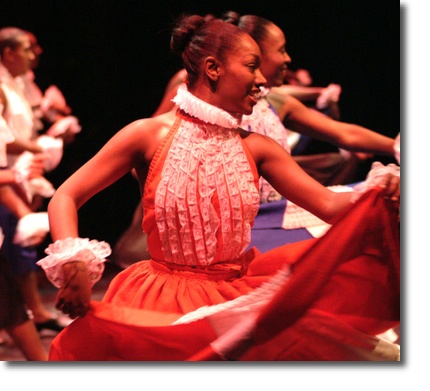
We saw and heard Perú Negro at Cleveland Museum of art in 2004 and we’ve been fans ever since. Hoping to learn more about the group, we spoke on the phone with Juan Morillo, President at Perú Negro Inc., on Wed 1/12/2011.
CoolCleveland: We were afraid we wouldn’t be able to talk with you before our deadline. On your website your North American tour doesn’t seem to start until 1/15/2011 in Montreal.
Juan Morillo: I came early. The group arrives Friday.
We found your article [on this] website very informative. Please give our readers some of the history of the African community in Peru and the background of Perú Negro.
Most people are surprised to learn that there are black people in Peru. What’s known about Peru is usually related to the legacy of the Incas, but, you know, Peru was a colony and like all the other colonies they had slavery. Peru was the center of the colonies in South America. Peru was where the gold and silver were to be found.
Somehow we’d guess that the African population of Peru was rather small.
Small compared to Brazil or Cuba perhaps, but early records going back to the founding of Lima show that there were more Africans there than Spaniards. In the beginning they were domestic servants. Later, when slavery increased, Africans became mostly farmers in the south of Peru. There was an attempt to take African slaves into the Andes and make them miners, but that didn’t work out. They never adapted to the climate and the geography.
As in every nation touched by the African Diaspora, there was an African musical influence that found its own unique form in Peru, but we understand that this African-Peruvian tradition was largely moribund until Ronaldo Campos (Ronaldo Campos de la Colina) started Peru Negro.
Yes. Ronaldo started out playing Creole music with other groups at places called peñas. Peñas used to be a kind of Peruvian social club where people would gather to listen to live music. Ronaldo was encouraged to begin showcasing black music, and that was the beginning, with family members and a couple of friends, of Perú Negro. In 1969 they went to the Hispano-American Festival of Song and Dance in Argentina and won grand prize.
Quite an auspicious start. Then, as explained in your article, and a book you refer us to, Black Rhythms of Peru by Heidi Feldman, Peru’s military government wanted to promote indigenous Peruvian culture, which gave Perú Negro a large assist. After a time, though, things changed.
Right. With the Shining Path, the ’80s and early ’90s were a time of intense terrorist activity in Peru. There was a curfew, public gatherings were banned and people were afraid to go out. That killed the live scene. Every kind of performance just died out. International touring is what saved Perú Negro at that point. Even today, Perú Negro is largely dependent on international touring. CD piracy undercuts commercial opportunities for musicians in Peru.
Now please give us some specifically musical background on Perú Negro.
Most people who know something about Peru think in terms of Andean music and the panpipes, a music which is very melancholic. The music of Afro-Peruvians, although it does have melancholic genres, is generally festive.
 Afro-Peruvian music is built around the Cajón, a wooden box used as a percussion instrument. There are a lot of stories about the origins of the Cajón, but unfortunately it’s not well documented. Written accounts by travelers mention the Cajón as early as the 17th century but nobody knows how it came to be an instrument. Some say that the Cajón first became a musical instrument on the loading docks where slaves were used to load ships heading back to Europe, which might make some sense, because that’s kind of like what happened in Cuba with some instruments.
Whatever the real origins of the Cajón, it’s become a successful instrument made by craftsmen and it has invaded different music around the world. Flamenco musicians now use the Cajón. You can even see pop artists using it. Christina Aguilera is using a Cajón in her band.
Peruvian Music conquers the world!
Well, the Peruvian Cajón, at least.
We understand that Perú Negro has been using congas for a long time, that this goes back to the 1950’s and a conguero named Jesus “el Niño” Nicasio.
Right. El Niño came to Peru like a lot of touring musicians from Cuba, but he fell in love and stayed.
He became friends with Ronaldo and taught Ronaldo how to adapt the congas to Afro-Peruvian music.
We understand that Perú Negro is very much a family affair. Ronaldo Campos’ son, also named Ronaldo, is currently directing the company. And El Nino’s son, Macario, and now his grandson, Macarito, plays with the group.
Right.
Please tell our readers about the musical forms. The landó.
The landó is a melancholic music, very soulful. It’s usually compared with the blues of the southern United States. In the old days, landós used to be about the evils of slavery. Then they became songs about failed relationships, lost love, the hardships of life. Zamba Malató is a landó.
[To see Perú Negro perform this dance, click on this link: PeruNegro.]
Speaking of the dances in Perú Negro, we read about Toro Mata, a dance which mocked the waltzes and minuets of the colonial masters.
Toro Mata will be in the program.
Excellent. What should we tell our readers about Eva Ayllón?
Eva is the Aretha Franklin of Peru, probably the most popular, best known singer of Peruvian music. In Peru she can fill a nightclub or a stadium. People in Peru of all classes, all social groups, are fans of her music.
We’ve certainly enjoyed listening to her. [EvaAyllon]
I hear we’re going to have a full house in Cleveland, so it will be great.
We’ll see you there. Thanks.
[Photos courtesy of CAMI]
Perú Negro & Eva Ayllón are part of the Cleveland Museum of Art VIVA! & Gala 2010 and 2011 season and the “Faces of Latina Performers” miniseries. See them at CMA’s Gartner Auditorium at 7:30PM on Fri 1/21/2011. Tickets $39 and down at http://ClevelandArt.org or phone 216-421-7350 or 888-CMA-0033. Student “Pay What You Can” tickets at the door.
 From Cool Cleveland contributors Elsa Johnson and Victor Lucas. Elsa and Vic are both longtime Clevelanders. Elsa is a landscape designer. She studied ballet as an avocation for 2 decades. Vic has been a dancer and dance teacher for most of his working life, performing in a number of dance companies in NYC and Cleveland. They write about dance as a way to learn more and keep in touch with the dance community. E-mail them at vicnelsaATearthlink.net.