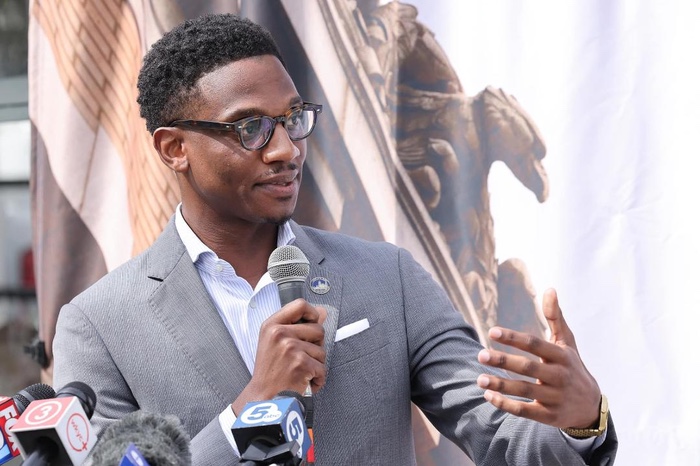
This past week a group of community activists known as the Accountable Cleveland Era took their first step to recall Cleveland Mayor Justin Bibb. The next step will be for the Clerk of Cleveland City Council to prepare petitions for the activists to circulate. Within 30 days of the receipt of the petitions, proponents must obtain the signatures of 20% of the voters who cast ballots in the last general election, which is approximately 8200 valid signatures.
If the group gathers the required number of signatures, city council is required to schedule a special election within the next 40-60 days after the recall petitions are presented to council, which would likely be in late summer.
In 2014 voters in Richmond Heights recalled Mayor Miesha Headon, who had only been in office 10 months. Her removal came after allegations of misspending and general government mismanagement. Last year, voters in Cleveland Heights voted to recall Mayor Khalil Seren, the first elected mayor of the city, over controversies involving his style of governing and issues regarding his wife’s involvement in governing the city.
Many Clevelanders will recall the 1978 recall of Mayor Dennis Kucinich. Kucinich managed to survive the recall vote by a margin of 236 votes but was defeated in the next election by Republican George Voinovich. Even though Kucinich had a successful post-mayoral career in the Ohio House and the United States Congress, his recall will always be a notable footnote to his term as mayor.
Thirty-eight-year-old Justin Bibb was elected mayor in 2021, on his first run for political office. His victory came about as he emerged as a relatively dark horse candidate from a crowded nonpartisan primary that included some prominent names, including Kucinich. Bibb went on to win the general election by defeating Cleveland City Councilman and Council President Kevin Kelley.
In his 2025 re-election bid, Bibb defeated Republican and perineal candidate Laverne Jones Gore, who ran a lackluster underfunded campaign. Bibb took 73% of the vote, garnering 32,049, but Gore still managed to garner almost 11,000 votes. The unfortunate part of the campaign was that only 18% of Cleveland voters even bothered to go to the polls, despite an election year that saw several hotly contested city council races.
This low voter turnout works to the advantage of the recall advocates because the number of signatures required to get a recall on the ballot is based on the number of people who voted in the last election. But on the other hand, getting 8200 valid signatures within 30 days is not an easy task.
The activists have some valid points to complain about. They cite Bibb’s $2,200 office chair, the $329,000 City Hall makeover and those pricey Martha’s Vineyard trips. The loss of the Browns Stadium to Brookpark will be high on the list of many voters, along with the loss of $3.3 million in lead-removal grants. In addition, several of his hiring decisions have raised questions about his judgment.
As recently reported here on CoolCleveland, City Council President Blaine Griffin and Mayor Bibb introduced emergency legislation in late 2022 to establish the Transformative Arts Fund, a $3 million initiative aimed at enhancing public art in communities with significant Black, Indigenous, and People of Color populations. The funds utilized federal funds from the American Rescue Plan Act, under the direction of Rhonda K. Brown, senior advisor for arts and culture for the city, who earns $250,000 a year funded by the Cleveland Foundation. The initiative has faced public criticism concerning the mismanagement of taxpayer’s funds and insufficient public awareness, and most recently a failure to respond to public records request regarding the status of the funds.
Bibb has done some good things, especially in the area of sustainability, attending conferences, serving on panels and speaking out about sustainability issues, making Cleveland a leader in the field. His friendship with former Transportation Secretary Pete Buttigieg has given him national visibility and the ability to travel in important circles which have been beneficial to the city.
Bibb’s plans for lakefront and downtown development are great projects. But these projects don’t do a lot for poor people living in the inner city. You can build a great park on the site of Burke Lakefront Airport, but if you don’t have a job, the money to buy gas to get there, or bus fare, these projects mean nothing. Voters are more concerned about their snow being plowed, police response time and putting bread on their table.
But Bibb also has some image problems. His casual appearance at public events has never set well with me. Going to a MLK Day program without a shirt and tie goes over like a ton of bricks with older voters. Appearing in a hoodie at public affairs doesn’t go well with a lot of voters. That is, when he shows up.
If I were Bibb’s political advisor, I’d be on his case about pressing more flesh locally and showing up at more public affairs. Surrogates don’t make it. Voters want to see who they voted for. Bibb apparently doesn’t realize that he doesn’t have the charisma of Carl Stokes or the political base of Mike White. Nor does he have years of experience in government like Frank Jackson.
Bibb always has his eye on the prize and that prize is his political future. The grapevine has him running for governor in 2030. What Bibb fails to realize is that for a Black candidate, mayor of the City of Cleveland is a dead-end street. Ask Carl Stokes and Mike White. George Voinovich went to the state house and the U.S. Senate, but he was white, a Republican and always had strong ethnic support.
These days, Democrats have a slim chance of getting elected statewide in Ohio, and if you add in the factor of race, you realize that Bibb’s chances of winning a statewide office are about the same odds as me running the Boston Marathon.
Bibb is a law school graduate, but he is not admitted to the bar in the State of Ohio. So he cannot run for judge, and he cannot seek employment at a law firm who would be happy to have a former mayor on their letterhead.
In my opinion, the chances of a successful recall are somewhere between slim and none. But Bibb should still take it seriously. He should see it as a warning. Recall attempts are like tattoos. They are written in indelible ink on your resume. Analize what the activists are saying you did wrong or what voters think you did wrong and fix it. It could mean the difference in your political future.

C. Ellen Connally is a retired judge of the Cleveland Municipal Court. From 2010 to 2014 she served as the President of the Cuyahoga County Council. An avid reader and student of American history, she is a former member of the Board of the Ohio History Connection, and past president of the Cleveland Civil War Round Table, and is currently vice president of the Cuyahoga County Soldiers and Sailors Monument Commission. She holds degrees from BGSU, CSU and is all but dissertation for a PhD from the University of Akron.