
At the age of fifteen Solomon Rabinovich adopted the pseudonym “Sholem Aleichem,” a Yiddish variant of the Hebrew expression meaning “peace be with you” and used as a greeting. As an adult he was a European “folkshrayer” (a folk-story teller) who wrote over forty volumes in Yiddish, thereby becoming a central figure in Jewish literature, best remembered for his fictional confessions, letters and monologues.
In spite of the success of Fiddler on the Roof today, Sholem Aleichem was not a successful playwright in the U.S. in his lifetime. When he came to the U.S. near the turn of the 20th century, his plays were not well received because they were “old-fashioned” and about experiences the newly arrived immigrants wanted to forget. Success came three years after his death, when the Yiddish theater actor Maurice Schwartz did an adaptation of Aleichem’s Tevye Der Milkhiker, which consists of eight of his tragic-comic stories.
Each of the tales had a farcical plot, employing stylistic humor, with a serious underbelly. In a classically rabbinic manner, Tevye, the main character, tells stories about his village of Anatevka and life with his wife Golda and his five daughters. He asks questions of God and sprinkles his speeches with “biblical verses.” Some of these are mangled and others are just made up.
Of the eight Tevye stories, five were later woven into the script of the musical, Fiddler on the Roof, which became a Tony award-winning musical. Mistakenly, many believe Fiddler is a translation of a play written in Yiddish (Jewish). It is not! The musical was written in English. It was not until 2018, when the National Yiddish Theatre, Folksbiene, mounted a Yiddish adaptation entitled Fidler Fan Dak that Fiddl Er was spoken and sung in Jewish.
The musical takes place in Tsarist Russia in 1905. Tevye attempts to maintain traditions while outside influences encroach upon century-long patterns. His three older daughters each make life changing decisions, which moves them further from customs of their faith, and an edict from the Tsar that evicts the Jews from their village further destroys life as Tevye has known it.
When Joseph Stein, Sheldon Harnick and Jerry Bock joined forces to write Fiddler on the Roof, now recognized as one of the greatest of American musicals, they did so in order to create an homage to their heritage. That heritage included hundreds of years of Jews in eastern Europe, whose lifestyle and lives had been destroyed by pogroms (uprisings), forced evacuations, and ultimately by the “final solution,” the Holocaust.
Traditions are the guts of the life of these people, for, as Tevye indicates, “A fiddler on the roof. Sounds crazy, no. But in our little village, you might say everyone is a fiddler on the roof. You might ask, ‘If it’s so dangerous there, why do we stay up?’ Because Anatevka is our home. And how do we keep our balance? That I can tell you in one word: Tradition!”
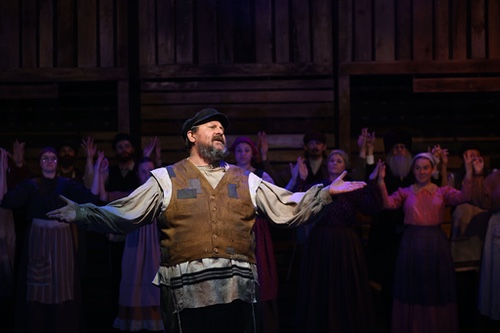
The original Broadway production, which opened in 1964, was the first run of a musical to surpass the 3,000-performance mark. In spite of original doubts that it would only be of interest to Jewish audiences, the show has been extraordinarily financially profitable and well-received. The original production was nominated for ten Tony Awards, winning nine, spawned four Broadway revivals, a film adaptation, and countless international, community and school productions, one of which is now on stage at Porthouse Theatre.
It may surprise many to know that Fiddler almost didn’t make it to Broadway. The show’s out-of-town tryouts were met with many of the audience walking out of the theaters before the final curtain.
When Jerome Robbins came in as the new director the problem was unearthed. He asked what the show was about. The usual answer was “a dairyman and his marriageable daughters.” It’s is recounted that Robbins said, “No, no, no, that’s no good.” Someone said, “It’s about the dissolution of traditions, a way of life.” Robbins responded, “Yes, that’s it. We have to establish the traditions at the beginning and then the audience will see how they’re breaking down. That’s the show! The song has to set up the major theme of the villagers trying to keep their society running as the world around them changes. It sets the show on a clear journey and the audience’s bought into the tale.”
So the song “Tradition” (“Traditsye”) replaced the original opening, “We’ve Never Missed a Sabbath Yet” which showed the frantic preparations for the Sabbath but not clearly enough to understand what was to come, a requirement for a musical opening song. Robbins added the circle entrance, holding hands, introducing the unity of people of Anatevka. Instead of walking out, audiences gave it standing ovations and a clear path to Broadway and beyond.
The script went through many titles including Tevye, A Village Story, To Life, Once There Was a Town, and Where Poppa Came From. Finally, the producers settled on the painting “The Fiddler” by Marc Chagall, one of many surreal paintings he created of Eastern European Jewish life. The fiddler is a metaphor for survival, through tradition and joyfulness, in a life of uncertainty and imbalance.
The story is carried through not only words, but significant and meaningful music and lyrics. The score includes such classics as “Matchmaker,” “If I Were a Rich Man,” “To Life,” and “Sunrise, Sunset.”
Confession: Inadvertently, I came to the show at Porthouse Theatre on the night of the preview performance, a no-no for reviewers. The comments which follow must be tempered by my not giving the performers and musicians the opportunity to properly prepare for being reviewed.
The role of Tevya will normally be played by Porthouse favorite and Kent State faculty member Tom Culver. His understudy, Baldwin Wallace University vocal performance major Aiden Eddy, performed the role at the preview. Eddy has a powerful and well-trained voice. He is a loving Tevya, much in the pattern of Broadway’s Luther Adler and the film’s Topol. Though there were laughs, he does not play for them through exaggeration as Harvey Fierstein and Zero Mostel did when they played the role. The scenes where Tevya’s resolves are tested are well-interpreted with sincerity and emotional confusion. He would have been more than acceptable as the “for-real” Tevya.
The production started with a twist on the norm: a Hebrew blessing, which was entirely appropriate, set a perfect tone for cuing the audience to the serious underpinning of the tale. The perfectly pronounced and cantorial sound of Noam Siegel, the recipient of the Dr. Roy Berko Endowed Commemorative Scholarship, was inspiring.
Tevye’s older daughters, Tzeitel (Marianna Young), Hodel (Ellie Stark) and Chava (Chloe Lee Hall), were all excellent. Stark’s character development and her vocal rendition “Far From the Home I Love” was a show highlight.
In most productions, the Fiddler appears at the beginning and end of the tale. Not so with Terri Kent’s inventive direction. Fiddler Jared Morisue-Lesser was intertwined within the tale, thus highlighting the importance of continued adherence to tradition throughout the show.
This bowing to tradition was also displayed in actors’ touching the mezuzah (a prayer scroll placed on the doorpost of a Jewish homes) and then kissing the fingers in respect to God, the appropriate wearing of prayer shawls and male head coverings, the kissing of a prayerbook when it was picked up after it was dropped on the floor, and the conservative women’s clothing.
The show’s highlight is Martin Céspedes’s inventive choreography. Every scene sparkled with meaningful movement. Mazal tov!
Many of the cast needed to keep in mind that there is a cadence to the way Yiddish, the language of the residences of Anatevka, is spoken. It is not an accent, but a rhythm. Accents need not be used, but the cadence is necessary to help create the “tam,” the taste, of the script.
Jennifer Korecki’s large orchestra was cantorial and klezmer-correct, but at times needed some work on the blending of sounds. This should come as the group plays the run of the show.
CAPSULE JUDGMENT: Reviewing a preview performance of a show is a disservice to the director, choreographer, musicians and cast. Usually this is the first chance to perform before and get used to an audience’s presence. But, seeing a preview I did, and I was pleased that director Terri Kent and choreographer Martin Cespedes’s Fiddler was generally set and ready, only needing little polishing needed in vocal cadence, keying and waiting for laughs, and some musical blending.

FIDDLER ON THE ROOF runs until August 11 at Porthouse Theatre on the grounds of Blossom Music Center. For tickets call 330-672-3884 or go to porthousetheatre.com.