Fri 5/9-Sun 5/18
Birds are in flight, stopping on the southern shores of Lake Erie before flying on to the Canadian boreal forests. Some make northeast Ohio their home, while others are migrants from south of the U.S. border. This is the perfect time to pay attention to and celebrate birds.
You’ve probably seen lots of activity in your backyard if you live near Lake Erie. We hear red-winged blackbirds and have spotted yellow goldfinch, mixed in with the cardinals, blue jays, robins and sparrows that we see all the time. On recent walks at Wendy Park and the Lakefront Nature Preserve in Cleveland, we saw and heard warbling vireos, Cape May warblers, grackles, wood thrush, yellow and bay breasted warblers, common yellow throats, brown-headed cowbirds, Carolina wrens, northern mockingbirds, and American pipits. Some of these birds migrate from as far as South America.
The place to go during May is the Black Swamp, out toward Toledo. The land there was once covered by impenetrable swamp in northwest Ohio and northeast Indiana along Lake Erie. The place was so difficult to pass through that in the mid-1800s, it was drained to create valuable farmland and provide a route to places west.
Today, the boardwalk over the wetlands at Maumee Bay State Park gives us a glimpse of what the area was like in the mid-19th century — forests open to wet grasslands and marshy prairies, and if you look closely, if you’re “mindful,” you see colorful birds in the foliage during migration time. One thousand acres of restored wetland along Lake Erie is now protected so that birds have shelter and can find food before their journey northward.
The first year we drove out to Magee Marsh to bird hunt, we had no idea what we were doing or how to do it. I created an itinerary by looking at the Ohio Department of Natural Resources’ Lake Erie Birding Trail that included Huron Harbor, Old Woman’s Creek, and Sherod Park. At our first stop, sharp-winged chimney swifts darted through the air, seagulls wailed overhead, and ducks swam alongside the docks. At our second stop, we saw herons and osprey. Next stop, we saw lots of seagulls and shorebirds.
We didn’t know that it was the biggest week of birding in America. The Biggest Week of American Birding, the 10-day festival that takes place in what is known as the “Warbler Capital of the World” and organized by the Black Swamp Bird Observatory, is coming to Oak Harbor, Ohio, during the week of May 9-18.
We should take busloads out there. It’s that special.
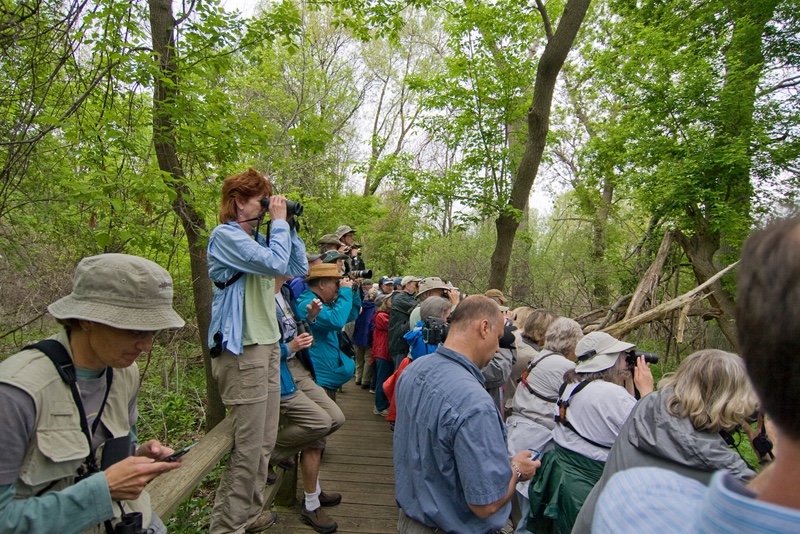
We arrived at Magee Marsh in the slanted sunlight of late afternoon. Hundreds of birders wearing khaki, hats and hiking boots crowded the boardwalk with their binoculars and long camera lenses. We followed the strangers, and they helpfully pointed and whispered the names of the birds, and then we could see the bright subtropical birds in the dense darkness of the forest. It was an amazing time. On our way to the parking lot and out onto the causeway, an owl watched us from the hollow of a tree, and when a bald eagle flew overhead, human voices rang out so all could see. We almost missed a heron on the bank of the creek because we were so deep in thought. On the ground we saw grackles in the decaying fallen leaves— we’d never seen a grackle before. Just like that, we were birders.
Birds have become part of our lives because of our experience in the Black Swamp. We have a Bird Buddy in our backyard that videotapes the birds that land there to feed. Red-headed woodpeckers, Carolina wrens and house finches take turns with the food. Our hummingbird feeder draws ruby-throated hummingbirds if we get the nectar out there soon enough in the spring. If we hear but cannot see a bird, our Merlin app tells us what species we hear. Because we’re now fascinated by birds, they are part of our lives, even when traveling. Condors in South America, the resplendent quetzal in Costa Rica, and the crowned crane in Kenya will never be forgotten.
Keynote speakers, guided hikes, workshops, evening socials and daily bird counts are all part of the fun at the bird festival. For example, Stephen Moss, who has travelled to all seven continents in search of wildlife and is one of Britain’s leading nature writers and broadcasters, will speak at Maumee Bay Lodge. Workshops include gull identification, choosing binoculars, and how to identify birds by their songs. Guided van trips are selling out.
The Biggest Week in American Birding festival takes place in multiple locations over the course of a week: Maumee Bay State Park in Oregon; Black Swamp Bird Observatory, Magee Marsh Wildlife Area Visitor’s Center, Ottawa National Wildlife Refuge in Oak Harbor. Information on the Biggest Week in American Birding can be found at biggestweekinamericanbirding.com, on Facebook as The Biggest Week in American Birding, @Biggest Week on Twitter, and as @biggestweek on Instagram. The cost for all programming is $55 for non-members, and $35 for Black Swamp Bird Observatory (BSBO) Members, but people can sign up for individual programs or explore on their own.
Claudia J. Taller has been writing for Cool Cleveland since shortly after its inception. She is the author of four books and has written many articles for local and national magazines. Find out more about her at http://claudiajtaller.com/.