
Our photo book from our South American trip was delivered yesterday. As I looked at the unbelievably bright pictures of Chilean and Argentinian Patagonia and the bustling cities of Santiago and Buenos Aires, I remembered our March trip as if we just returned home yesterday. Travel is, above all, transformative. That trip showed us a world that is very much like ours.
Once a broad wilderness with peaceful people fishing and foraging, the conquistadors marched in and conquered it in the narcissistic way Europeans always have. Refugees and immigrants flocked into that mostly Spanish-speaking world in the early twentieth century—in Argentina, it seems like half the country is Italian. Chile and Argentina both suffered “disappearances” and vengeful rulers in the late twentieth century. They are democracies today.
We went to South America to see the natural beauty of a watery world just north of Antarctica. Our tour company coordinated four flights between Cleveland and South America, three intercontinental flights, bus tours, a ferry ride out of Ushuaia, twelve overnight stays, local tours every day, and most of our meals during our two-week trip. We packed knowing it would be like summertime in the cities near the equator and that temperatures in Patagonia would barely reach 50 degrees.
We arrived at the Sheraton Santiago and soon set off to explore the city on our own. Behind our hotel, cable cars moved along San Cristobal Hill in Park Metropolis. At the summit, we found the sanctuary dedicated to the Immaculate Conception with its iconic 22-meter statue of the Blessed Virgin Mary, an amphitheater, a chapel and tiered gardens. All around us, on all sides, were the Andes Mountains, which would be our companions throughout the journey. A vernacular took us downhill to the “bohemian” Bellavista neighborhood where we had our first pisco sour and lunch. Dinner outside near the pool made things simple.

The next day, our formal bus tour rolled past 19th-century mansions and palaces now converted to other uses before we entered Park Bicentenario and walked under queen palm, oak, and plane trees while spotting black-necked swans, herons and flamingos against the backdrop of skyscrapers. At the Plaza de la Constitucion, we were introduced to La Moneda Palace, the Plaza de Armas, and the Cathedral. Happy hour found us at a typical bar where we were serenaded by an accordion-playing folk singer and ate seafood at the marketplace.
We flew into Puerto Arenas on the Strait of Magellan on the third day and drove through the Patagonian steppe. We passed rivers, forests and low mountains in a brown landscape and saw our first guanacos, including some lonely older males, amongst the sagebrush-type plants. Large remote ranches popped up with long intervals between them, and most of the time, our bus was the only vehicle on the road.
Four hours later, we were at Remota Patagonia Lodge, whose low-slung buildings designed by award-winning architect Germán del Sol sat in a field of tall dry grasses that hid numerous hares. The view of the shimmering Señoret Channel framed by low subdued mountains at dusk made us long for a walk along the water, but we satisfied ourselves with a stroll about the property and the interior common areas before dinner. In my journal I wrote, “Remota was beautiful, everything sophisticated casual and artsy. We had drinks at the bar, Chilean wine, and earthy mushroom soup to begin with. Paul had shrimp risotto and I chose salmon with saffron sauce. Dessert was Calafate ice cream with cream and sprinkles in a baked shell. The food was fresh, locally sourced, and inventive.” Our travel companions were avid travelers and nature lovers—we had a lot in common.
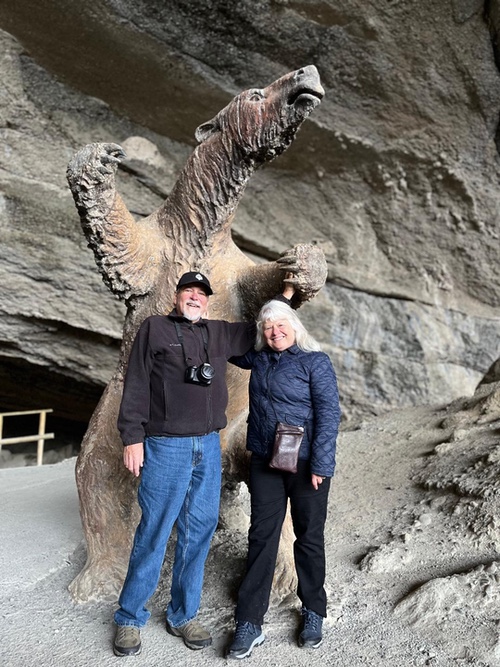
To the north of Puerto Natales is the vast Mylodon Cave, once inhabited by prehistoric, sloth-like mylodons and other animals whose fossils date back to 14,000 years ago. In an enormous open cave, our local guide told us which skeletal remains were found, introduced us to some of the flora, and gave us a feel for what the world was like when the mylodons shook the ground with their footsteps. Later, as we drove across arid Chilean Patagonia through the Andes, the peaks of Torres del Paine rose in the distance. Along the way, we saw condors, eagles, guanacos, grey fox, and sheep. Everyone was taking pictures.
The Hotel Las Torres was once a fishing lodge in Torres del Paine National Park, and when it opened as a hotel in 1968, it was the only one in the area. Now an all-inclusive resort-like dwelling with a two-story teepee-like lobby, it provides superb hospitality. At Bar Pionero, an award-winning sustainable cocktail bar, the bartenders use frozen mountain stones soaked in brine as ice, and the unusual straws were made of copper. We ate sea bass ravioli in a seaweed broth, Hake white fish with mashed potatoes swirled with avocado, salmon tartare, pumpkin bites, and chocolate mousse during our two-night stay. The hotel has its own vegetable garden, greenhouses, and orchards, whose bounty is harvested for the kitchen which uses all of it in its creative dishes, including flowers. During our garden tour, we learned how they prepare for winter, plant companionable plants (like basil and tomatoes) together, and manage half a dozen greenhouses.
The morning after our arrival, we took a four-hour hike on rough and rolling terrain past waterfalls and rainbows, to a lookout point of the mountains. We saw caracaras and grey fox. At Lago Grey, we hiked on a rocky beach to Grey Glacier with its floating icebergs. The creeks, shimmering lakes and jagged mountain peaks were awesome. Overhead, wild geese, parakeets, eagles, and condors. On our way to the Blue Lagoon, we saw two baby puma kittens by the side of the road, very young and frightened. Right after, as we passed through a ranch community, a herd of guanacos, including chalupa (babies), and sheep crossed the road, herded by one of the white Moratto dogs recently brought into the park and trained to keep the pumas away.
While at breakfast on our second morning, we saw a threesome of pumas walking across the lawn while the hotel’s animal herders used sticks to keep them away from guests. Later, we took a morning walk to spend more time looking at Las Cuernos, or “the horns,” the iconic jagged granite peaks that loom over the windswept plains. We were on our way to El Calafate, a town of 25,000 and originally a simple sheltering destination for wool traders. No longer the scraggy cliffs of Torres del Paine, we were in a dull lifeless brown place and did not arrive at Mirador del Lago overlooking Lago Argentino until night was approaching.

We were unprepared for the amazing beauty of the Perito Moreno Glacier (another UNESCO World Heritage Site), which forms part of the Patagonian Continental Ice Field, in Los Glaciares National Park. The glacial towers at the head of the ice fields average a height of 230 feet. During our walking tour along the catwalks, we often heard, and then saw, ice calve into the turquoise water and dissolve into icebergs. Between the southern and northern faces of the glacier is a place where grey silty water hits turquoise blue, and beyond the face of the mountain the 100-plus mile long ice field pushes against the banks of the rivers.
At the Glacierium the next day, we learned how glaciers are formed while our guide showed us where the glaciers are on a huge topographical map. We explored the museum exhibits and then had fun at the Ice Bar. We were decked out in fake fur capes and gloves while drinking vodka and gin from glasses made of ice. The bar turned out to be a room with some angles, all of it ice, including the bar, benches, the floor, and our drinking glasses. Disco music got us dancing, a sight to see. It was fun!
Later we drove out to Estancia Nibepo Aike. After going through the gates and getting a brief introduction to settler life, we experienced the essence of early 20th century ranching life. We milked a cow, walked to the glacial lake, saw sheep being sheared and herded into their enclosure for the night, and ate a mediocre traditional lamb and beef barbecue dinner. Did you know that if sheep don’t get sheared three times a year, they fall over from the weight of the wool and can die? The mission of Nibepo Aike is to preserve the essence of the old Patagonian ranches amid stunning views. As night descended, we saw the Southern Cross in the deep black sky..

After a morning at leisure strolling along the lakeshore and past downtown shops and restaurants in Calafate, we grabbed some empanadas before boarding a plane for Ushuaia. We landed at the city at the “end of the world” near Tierra Del Fuego on the Beagle Channel. The port serves tourists, mostly cruise ships going to Antarctica, 500 miles to the south. We stayed in apartment homes and enjoyed walking through the busy downtown and harbor. We had dinner at the “pink house,” famous for crab, where most of our other tour-group travelers ended up.
The next day was tour day 9. We boarded our bus at eight in the morning for our four-hour tour of Tierra del Fuego National Park, which Magellan saw on arrival in 1520. The archipelago off the southernmost tip of the South American mainland is two-thirds part of Chile; the southernmost island is Cape Horn, and directly south of the largest island is the Beagle Channel where Ushuaia is the largest port. Our local guide took us a leisurely walk through meadows that supported berry bushes, grape leaf begonia, forest mistletoe, and various ferns. Fall on the tip of South America. We passed a sign that commemorated the spot where the Pan American highway, which begins in Alaska, ends. Now that would be some road trip.

The bus then took us to the Casimiro Biguá Parrilla & Restaurant near the ferry station for lunch. We had a big meal that began with wine, appetizer empanadas, salad, bread, and huge platters of lamb and beef. A short walk took us to the ferry terminal for a six-hour ferry cruise on the Beagle Channel–our destination was Martillo Island, home to Megellanic penguins, black and white cormorants, and climbing-over-each-other sea lions. On the waterway, we saw humpback whales in the water, rainbows in the sky, the red and white striped Les Eclaireurs Lighthouse on top of rocks where birds congregated. At the end of the evening, we walked down the street to have pizza at Krund, a lively “Primer Bar Antartico de Ushuaia” that serves good pizza.
Late the next morning, we flew from Ushuaia to Buenos Aires. Local tour guide Maria grew up near the port and attended mass at the Metropolitan Cathedral where Pope Francis served as a priest. What a beautiful multicultural cosmopolitan city she showed us! Fredos for ice cream, Athena for books, storefront cafes for pastry, tents for artists during an arts festival, and fabulous palaces that are living out second lives. We passed the Spaniards monument commemorating Argentinean Independence, the railroad station, and the fine arts museum.
Soon after arrival at the elegant Loi Suites Recoleta Hotel, we left for a 5-course meal with wine pairing at the Argentine Experience. We learned that Matte tea is made from Mattiendo and grows in specific place in South America influenced by Indian culture and that the standard matte cup is a pumpkin. We designed our own empanadas—mine was in the shape of a butterfly—and they returned them to us after baking. The food, including ossobuco, was served in generous portions with cultural insights and high-quality service in a beautifully decorated dining room. It was a memorable evening.
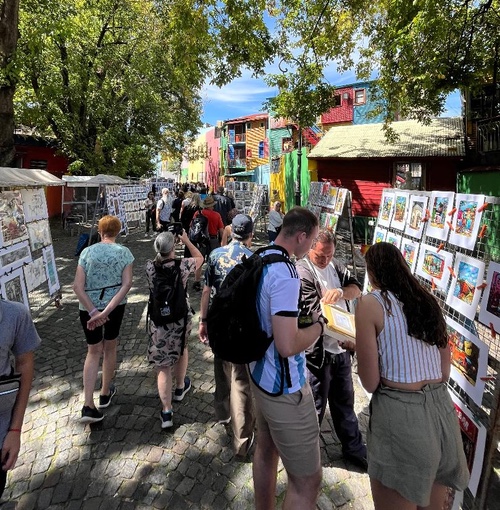
After breakfast at the beautiful Jardin Invierno restaurant at our hotel, our group walked over to Recoleta Cemetery, which is filled with 1470 mausoleums, all different and reflective of the families that own them, some of which date back to the early 1700s. Then our guide showed us the palaces, hotels, and embassies in Little Paloma. Once we reached the Plaza de Mayo, we disembarked and walked amongst late-colonial buildings, including the President’s Pink House and the Metropolitan Cathedral which was packed for a coronation. The bus left us at LaBoca, the old port of the city, to explore the colorful buildings, whimsical sculptures, wall murals, food vendors, and the energy of the people. Martin Braun murals depict football and tango on underpass walls; other murals are painted on buildings. We were delighted to see a couple dancing the tango on a city sidewalk. Back at the hotel, we took a walk to Ateneo (Athena) Grand Splendid bookstore which was a gorgeous example of early 20th-century craftsmanship in an old theater.

That evening, we dressed up for our tango evening. We climbed stairs in an old building to an open area and sipped wine while a couple performed, then those who wanted it enjoyed a tango lesson. We had a good dinner on the first floor then we walked across the street for a tango performance at the 18th-century theater across the street. When we arrived at the hotel, Carolina bid us farewell. We were on our own and would spend our last day shopping, ice cream, city parks, an art festival, and an early Italian dinner with newfound friends before heading to the airport and our flight home.
Knowing that both Chile and Argentina suffered losses during their authoritarian regimes and are now peaceful and united gave me hope. The people are committed to keeping their natural areas accessible and well-maintained, and the beauty of that part of the world is awe-inspiring. The region is leveraging its natural resources to drive a sustainable economy and address global climate change. South American culture is vibrant and diverse, and visitors feel the influence of indigenous traditions and colonization. The journey will remain in my memory and has influenced how I feel about our southern neighbors.
