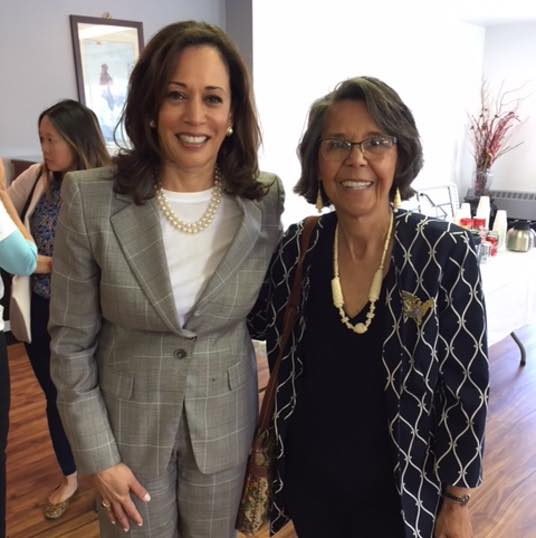
Former Vice President Kamala Harris takes 300 pages her in new memoir, 107 Days (Simon and Shuster, 2025), to recap her thoughts, reflections and the challenges of the 2024 presidential race. Sadly, the entire book can be summarized in one sentence on page 299: One hundred and seven days were not, in the end, long enough to accomplish the task of winning the presidency.
In a New York Times opinion piece published on September 27, 2025, the three reviewers argue that the subtitle should have been “Excuses.” I’m not sure that I would go that far, but Harris comes across somewhat whiny and defensive as she chronicles the roughly three and a half months between President Joe Biden dropping out of the race and the final vote count on Election Day, November 5, 2024.
Even while holding the historic position of being the first woman and the first Black Vice President, in a sense Harris started out behind the eight ball in terms of the length of her campaign and the nontraditional way that she became the candidate.
The vice presidency has not been a steppingstone to the White House. The only Vice President in the 20thcentury to ascend to the presidency immediately after serving as Vice President was George H. W. Bush in 1989 when he followed Ronald Reagan into the Oval Office. The more common experience is what happened to Vice President Hubert Humphrey in 1968. Humphrey had to wear the jacket for Lyndon Johnson’s policies in the Vietnam War. The nation’s dissatisfaction with Johnson carried over to Humphrey and he could not distance himself.
Biden’s frequent comment that Harris was the last person in the room when he made decisions was initially positive for her image as essentially a president in training. But as Biden fumbled and fell in the polls, especially after the disastrous debate, the public questioned his decisions and his poll numbers tanked. Biden’s flawed image rubbed off Harris.
Presidential campaigns can turn on a single gaff. In October, Harris appeared on ABC’s The View, a traditionally friendly audience for Black women. When asked what she would have done differently than Joe Biden, her response was “nothing I can think of comes to mind.” Historians will likely look back at that moment as a nail in the Harris campaign coffin.
Vice presidents turned presidential candidates must walk a fine line when running to succeed the president they served under. They are essentially between a rock and a hard place. How do you put forth a new agenda or distance yourself from your predecessor and not look like an ingrate to the person who selected you in hold the office? Loyalty is an important asset to any candidate. And Harris did not want to run the risk of turning off old time Biden supporters with any criticism of him. She was damned if she criticized Biden and appeared weak for not criticizing him.
Harris discusses at some length the process that she used to decide on a running mate. After being turned down by at least two Democratic governors who took themselves out of the running, the choices were narrowed to Pennsylvania Governor Josh Shapiro, Arizona Senator and former astronaut Mark Kelly and Minnesota Governor Tim Walz.
Harris feared that Shapiro was not a team player and would overshadow her. Between the lines, it’s clear that she did not want to give Shapiro a jumpstart on the 2028 campaign.
She found Mark Kelly impressive but not particularly dynamic in terms of speaking style. I assume that she settled on Walz, who said he had no presidential ambitions, because he fit the all-American mold of the small-town father, coach and veteran. As a white male from the Midwest, I assume that he was seen as a candidate who could balance the ticket and that average Americans would identify with him. But political pundits will debate the wisdom of the choice for decades. Could another choice have strengthened the ticket?
She also reveals that her first choice would have been Transportation Secretary Pete Buttigieg. I appreciate her candor, but if Americans did not vote for a white woman in 2016, there is no way that they would vote for a ticket with a Black woman and a gay man. Maybe she should have left that comment on the cutting room floor.
Throughout the book, which is essentially a daily journal, she is optimistic as to her chances at victory as she traces her journey around the United States and her interactions with voters and big money donors. She has a lot of tidbits about her nieces and family, which is kind of a homey touch but got to the point of seeming trite.
I admit that I had no expectation of buying the book. I knew it could only be a postmortem on a failed campaign and only make me more depressed about the outcome. However, a friend gave it to me, so I felt compelled to read it. I’m grateful for his kindness, but I can’t say that I enjoyed the read or would I recommend it to anyone else. It’s like reading a murder mystery when you already know how it ends.
As an amateur student of presidential history, I believe that future presidential historians will put the blame for the Democratic defeat of 2024 solidly on Joe Biden, and to some extent Jill Biden, who apparently never had good karma with Kamala. The lack of a clear message from of the national Democratic party and a blueprint on how it would lead a government that truly works for all the American people did not help.
An earlier decision by Biden could have changed history. Even with the slim farm team that the Democratic party has, Harris or someone else could have risen to the top through the primary process and created grass roots appeals, a clear message and time to create a national organization. Who could have predicted Barack Obama’s meteoric rise from state senator to the White House?
Harris concludes by saying that she was defeated by 1.5 percentage points in one of the closest elections in century. The problem with the analogy is that close is only good in horseshoes and hand grenades.
Some memoirs are written to launch or enhance the candidacy of the writer. Some are written at the end of a career, where the writer tells all and exposes whatever they have been reluctant to say while they were still a viable candidate. And some memories are written too quickly — before the dust settles to keep the candidate in the public eye. That seems to be the message of 107 Days.
Frankly, I feel rather guilty about writing this review. As a dyed-in-the-wool Democrat, I hate to criticize one of my own, but sadly, if the shoe fits you have to wear it.

C. Ellen Connally is a retired judge of the Cleveland Municipal Court. From 2010 to 2014 she served as the President of the Cuyahoga County Council. An avid reader and student of American history, she is a former member of the Board of the Ohio History Connection, and past president of the Cleveland Civil War Round Table, and is currently vice president of the Cuyahoga County Soldiers and Sailors Monument Commission. She holds degrees from BGSU, CSU and is all but dissertation for a PhD from the University of Akron.
2 Responses to “BOOK REVIEW: “107 Days” by Kamala Harris, Reviewed by C. Ellen Connally”
Mel Maurer
Thanks for this assessment. It seems she didn’t do herself any good with it. Unfortunately, I think a white candidate could have won. The bigot vote gave it to Trump. Maybe even a white woman.
Yvonne McGhee James
Ellen, an excellent critic on Kamala Harris ‘ book. Thanks for the review. I will not read her book.