Pictured Rocks National Seashore, the Upper Peninsula, Sleeping Bear Dunes, and the Traverse City Area are wonderful in early October. We went at the beginning of October last year, and it was the last week for Pictured Rocks National Seashore tours and the height of fall color. The weather was cool, but perfect for being outdoors.
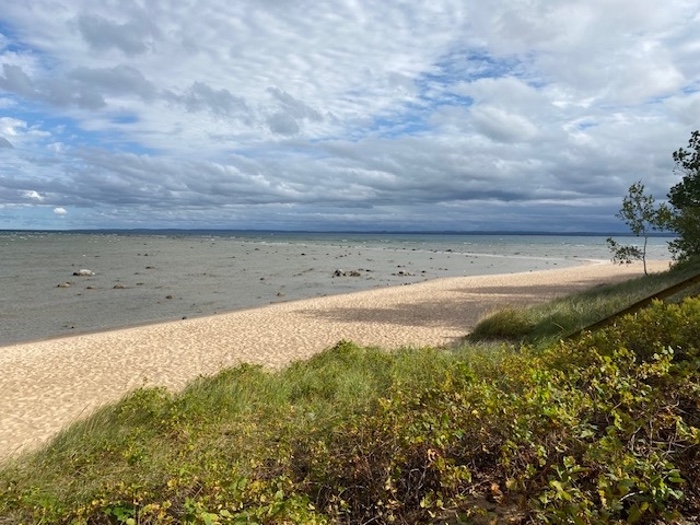
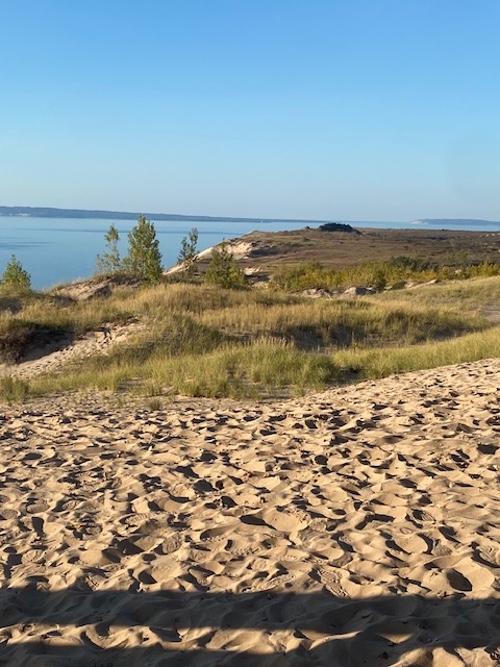
We drove straight through to Sleeping Bear Dunes National Seashore, a six-hour drive from our western Cuyahoga County starting point. Lake Michigan and the largest moving sand dunes in the world did not disappoint—the water is like the ocean, white sand is everywhere, and even though it was prime time for fall color, we saw few visitors. We drove the Pierce Stocking scenic loop trail that stops at beaches and points of interest, like Glen Lake with its deep blue water, a lake carved out, as most of the area was, by glaciers, with Alligator Hill in the midst of it. At the Dune Overlook and from the Cottonwood Trail, we viewed the dunes from above, then hiked sandy trails through dune grasses and scrub. Lake Michigan overlook, 450 feet above Lake Michigan, and North Bar Lake Overlook gave us awesome landscape views.

Traverse City, which is influenced by the Native American peoples and French settlers on La Grand Traverse Bay, was pleasant. Both nights of our stay we walked to nearby restaurants for dinner and were happy to indulge in smoked food and local beers at Red Mesa Grill and Smoke and Porter. We could see Grand Traverse Bay across the street and walk in a nearby state park. The air was crisp but not cold, the poplars were bright yellow, and the maples were a vibrant pinkish red. The hot tub at the Blossom Hotel & Suites was perfect after our days of shopping downtown and visiting the wineries of the Old Mission Peninsula American Viticultural Area.

There are ten wineries on Old Mission Peninsula Wine Trail. It is not a long trail. We drove to the historic Old Mission Lighthouse at the northern tip of the peninsula, then headed south. The views of the vineyards at Chateau Chantel, our first stop, were breathtaking and after tasting several of the wines, we bought two glasses of wine and a charcuterie board. The tasting rooms of Mari Vineyards, further south, are in a beautiful Tuscan-style building where we found seats by the fireplace to relax and sip wine. Our last stop was Black Star Farms, an older winery with a simple tasting room, where we bought two bottles (a pinot noir and a chardonnay) to take with us.
We traveled across the Mackinaw Island Bridge, through St. Ignace, considered the gateway to Upper Peninsula, and went on to Sault Ste Marie after leaving Traverse City. The wilderness of UP felt more like Canada than the U.S. Our visit to the Soo Locks Visitors Center featured topographical maps that showed the difference in depths of the Great Lakes and trading routes, and chronicled the construction and the men that made the Locks possible. From the viewing platform, we watched how a tour boat and a huge 1000-foot freighter made their way from Lake Huron to Lake Superior and from Lake Superior to Lake Huron. It was more interesting than I thought it would be.
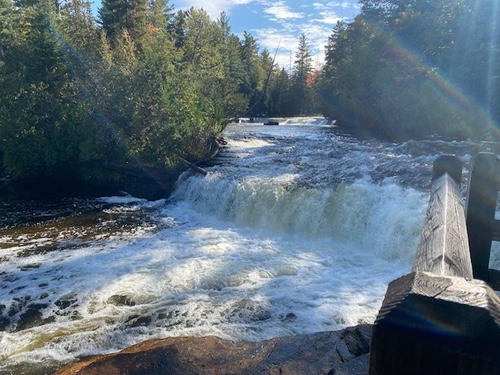
Then we drove north to wooded Tahquamenon Falls State Park. The high-volume waterfalls spread out on either side of an island. It felt holy to stand and listen and watch, the way deep woods always feel. I took a photo of a “Prayer of the Woods” sign: “I am the heat of your hearth on the cold winter nights, the friendly shade screening you from the summer sun, and my fruits are refreshing draughts quenching your thirst as you journey on. I am the beam that holds your house, the board of your table, the bed on which you lie, and the timber that builds your boat. I am the handle of your hoe, the door of your homestead, the wood of your cradle, and the shell of your coffin. I am the bread of kindness and the flower of beauty. Ye who pass by. Listen to my prayer . . . harm me not.” We allowed ourselves to be enfolded in the arms of the woods around us.
It was a long drive through undeveloped Hiawatha National Forest, which is home to dozens of trails and waterfalls. The town of Munising offered few choices for dinner—we settled on the popular Dog Patch, which had a line, and one impatient guest complained, “There isn’t a choice.” True, so we sat at the bar of the kitschy Lil’ Abner themed restaurant and ordered whitefish sandwiches. The hot tub in at the high-ceilinged wood-paneled pool area of the AmericInn was a welcoming ending to our travel day.
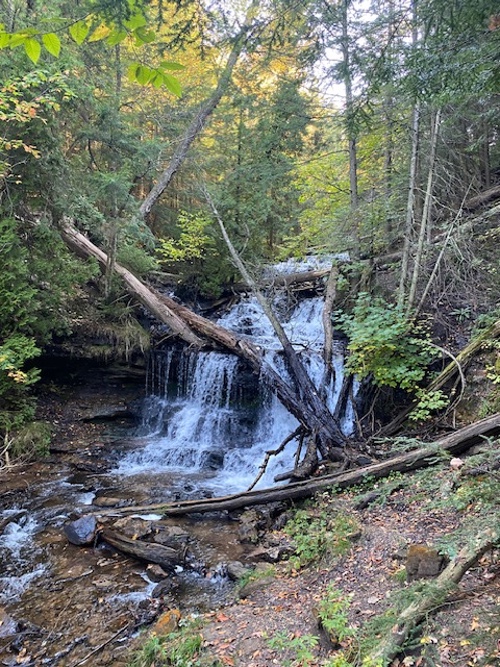
The area near Pictured Rocks is known for its waterfalls. We entered the National Seashore through Hiawatha National Forest on dirt and gravel roads to find Wagner’s Falls, which is a series of falls flowing over terraced rocks. From there, we walked on the wide beach and sandy promenades that took us out into the bay on sandbars scattered with driftwood and manmade teepees. Across the water, the historic lighthouse at Sand Point felt remote.
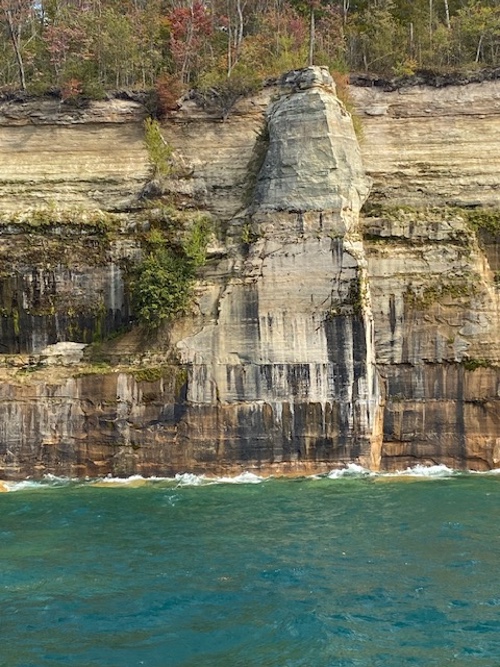
In downtown Munising, we visited the Pictured Rocks interpretive center and learned about the minerals that give the tall sandstone cliffs their colors. We had a reservation for the Classic 2 1/2-hour lake tour. From the top deck, we took picture after picture after picture of the colored cliffsides and unusual rock formations made by the wind and water while the catamaran navigated two-to-four-foot waves. We went past the lighthouse on Grand Island and were able to get a closer view of the unique old-fashioned Sand Point lighthouse where the lightkeeper, his wife, and ten kids lived in seclusion for years.
That night, we ate at the Buckhorn Resort Restaurant, a rustic building with a view of the setting sun over the lake. I enjoyed the whitefish dinner at the homey restaurant whose big windows overlooked Hovey Lake. Casual in an elegant kind of way, it reminded us of comfortable National Parks restaurants. We overstayed—the roads in the wilderness were dark and we had no cell phone service—but our car compass and instincts got us back to the inn.
The following day, we walked the trail to Miners Falls, which was a good long hike, and then walked on the beach before driving west to Marquette along the Lake Michigan shore. We wandered around Presque Isle Park, then found our way to the historic downtown. We ate our last dinner at the 140-year-old Vierling Restaurant and Marquette Harbor Brewery and were impressed by the art-filled walls, Victorian décor, craft beers, and local seafood.
We want to go back to Michigan. We could spend more time at coastal towns and Mackinaw Island, which we visited years ago, and explore Keweenaw Peninsula, the Great Lakes Shipwrecks Historical Society, and turquoise-blue Torch Lake. We haven’t been to Detroit, which has been having a renewal, in decades. But the real attractions are the hiking trails, beaches, lighthouses, waterfalls, local breweries, and whitefish suppers. “Pure Michigan” is an appropriate slogan.
One Response to “Get Out of State for a Mini Michigan Vacation by Claudia J. Taller”
John
My home state. Glad you liked it. It’s pretty nice when I get to go home to visit.