A CNN poll released this weekend shows Vice President J.D. Vance as the front runner for the Republican nomination in 2028. While most people assume that the vice presidency is a steppingstone to the White House, history does not bear that out. Only 15 of the 49 vice presidents in the country’s history have become president. In fact, some political scientists argue that the vice presidency can be a dead-end job. Ask Walter Mondale, Al Gore and Dan Quayle.
Some of the most obscure figures in American political history are defeated vice presidential candidates. Who remembers who ran with Adlai Stevenson in 1952 or more recently, who ran with Hilliary Clinton in 2016? Franklin Roosevelt ran as the unsuccessful Democratic vice-presidential candidate in 1920 with Ohioan James Cox. He ran at the top of the ticket 1932 and won. His success was the exception rather than rule. Most unsuccessful vice-presidential candidates ride off into the sunset and become the fodder for Double Jeopardy and trivia contests.
Political folklore has it that Lyndon Johnson had his aides research his odds of gaining the presidency when he was deciding whether to accept the nomination to run with John F. Kennedy in 1960. He is alleged to have told supporters that his odds were one in eight. And he was a betting man.
Since 1933, only five vice presidents have succeeded to the presidency: Harry Truman, Lyndon Johnson, Richard Nixon, George H.W. Bush and Joe Biden. Truman and Johnson were elected after ascending to the presidency after the death of their predecessor. Only Bush succeeded his predecessor, Ronald Reagan. Nixon, who served as vice president under Dwight Eisenhower from 1953-1961 was not elected president until 1968, in one of presidential history’s biggest come-backs. And Biden had to sit out the four years of the first Trump administration to win the office he has sought so many times.
In 1976, voters rejected President Gerald Ford, who had become president after the resignation of Nixon. Ford’s pardon of Nixon was a substantial factor in his defeat. Voters also rejected Humbert Humphrey’s bid to succeed LBJ in 1968, largely because of LBJ’s association with the war in Vietnam.
Most recently, Vice President Kamala Harris lost in her bid to succeed Joe Biden. Facing the disadvantage of a short campaign, with no primary contest to build support and gender and racial bias, she faced an uphill battle. Her inability to distance herself from the perceived problems of the Biden administration was a key faction in her defeat. Like other vice presidents seeking the presidency, Harris had to wear the jacket for everything the prior administration did or did not do.
John Tyler was the first vice president to ascend to the presidency on the death of William Henry Harrison in 1841. Tyler set the precedent for succession to the presidency by immediately taking the oath of office and assuming the powers of the presidency. But in so doing, he broke ranks with the predecessor’s supporters and failed to win a full term. Likewise, Millard Filmore, Andrew Johnson and Chester Arthur failed to win a full term after ascending to the presidency after the death of their predecessor.
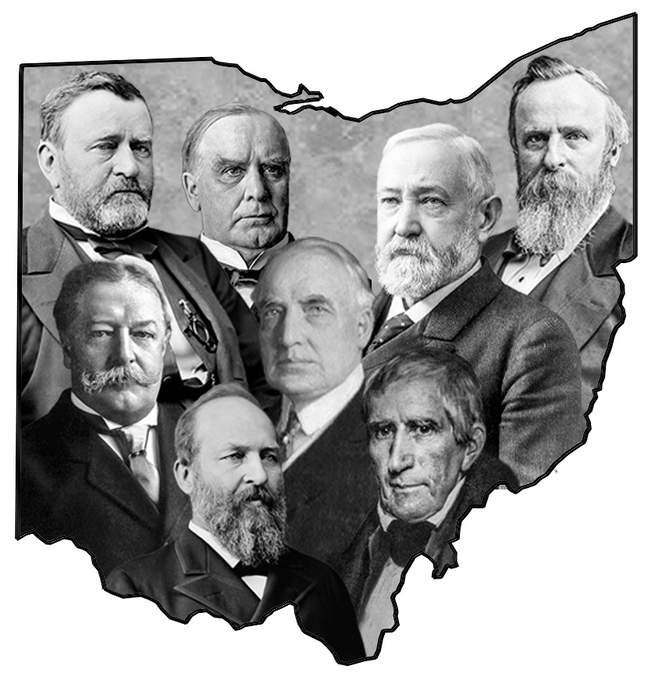
In terms of place of birth, the odds are on Vance’s side. Eight presidents were born in Ohio. Two Ohioans were elected in the 20th century—William Howard Taft in 1909 and Warren G. Harding, in 1920. But other 20th century Ohio presidential hopefuls, namely Senator Robert Taft and Senator John Glenn, did not fare well. In 2020, former Ohio Governor John Kasich sought the Republican nomination but did not make it out of the Republican primary.
Vance first made a name for himself as the author the best-selling book, Hillbilly Elegy – A Memoir of a Family and Culture in Crises (2016). When the book was made into a movie, Vance’s notoriety and pocketbook got a big boost.
In 2020, he made his first run for political office when he entered a crowded Ohio Republican primary for the seat vacated by Senator Rob Portman. The field included former Ohio Treasurer Josh Mandel, former State Senator Matt Dolan, investment broker Matt Gibbons and former Ohio Republican Party Chair Jane Timken.
With a huge financial boost from entrepreneur and venture capitalist Peter Thiel — reportedly in the millions — and the imprimatur of Donald Trump, allegedly thanks to a friendship with Don Jr., Vance emerged with 32% of the vote — enough to win the primary, but not exactly a mandate from the people or evidence of a strong political base. Vance defeated Democrat Tim Ryan in the general election.
On January 10, 2025, after two years and one week into a lackluster career in the Senate, Vance resigned to serve as vice president, making him a heartbeat away from the presidency. The question is, is that as close as he will get?
Vance has the remainder of Trump’s term to enhance his political capital and create his own political base. He cannot rely on Trump’s MAGA base. There is no guarantee that the Trump allure will transfer to another candidate, especially someone whose name is not Trump. And if Trump’s rating sinks in the polls, Vance goes down with him.
Vance must walk a fine line and stay in lockstep with every Trump decision. There is no room for disagreement in Trump world. Ask former Vice President Mike Pence, who went from a sycophantic party darling to a pariah after he disagreed with Trump. And with Donald Trump Jr., Eric Trump and Marco Rubio waiting in the wings, Vance must watch his every move. The long knives could be waiting.
Is Ohio, the mother of presidents, pregnant again? Only time will tell. The political ups and downs of the Trump administration; the economy; the wars in Gaza and Ukraine; and maybe even the revelations of the Jeffery Epstein files could be the determining factors, none of which Vance has any control over. Vance could be in a similar position as Humphrey in 1968. The baggage from the prior administration could be too heavy to carry.
But here’s a couple of interesting bits of historical trivia. Vance, born in Middletown, Ohio, has facial hair. He’s the first vice president with facial hair since Chales W. Fairbanks, elected in 1905. Fairbanks was a native of Ohio. William Howard Taft is the last president with facial hair. He was elected in 1909 and born in Ohio. Of the eight Ohio presidents, in addition to Taft, Benjamin Harrison, U.S. Grant, Rutherford B. Hayes and James Garfield all had facial hair. Can Vance continue the the trend? We have until 2026 or so to find out.

C. Ellen Connally is a retired judge of the Cleveland Municipal Court. From 2010 to 2014 she served as the President of the Cuyahoga County Council. An avid reader and student of American history, she is a former member of the Board of the Ohio History Connection, and past president of the Cleveland Civil War Round Table, and is currently vice president of the Cuyahoga County Soldiers and Sailors Monument Commission. She holds degrees from BGSU, CSU and is all but dissertation for a PhD from the University of Akron.
2 Responses to “President JD Vance: Can He Win by a Hair? by C. Ellen Connally”
Penny Jeffrey
Thanks, Ms Connally for that succinct history of Ohio presidents, and the vice presidential shuffle.
joanne rassie
I hope people will come to their senses…and his beautiful wife, too