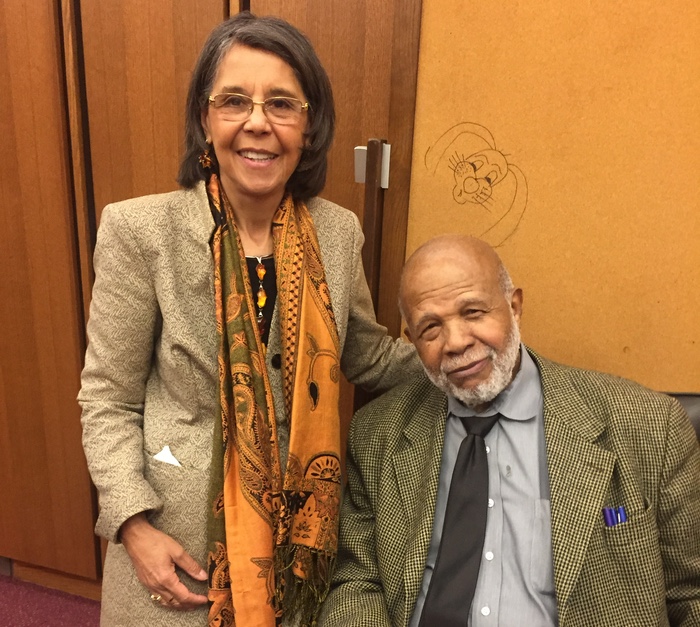
The first Black lawyer to argue a case before the United States Supreme Court was Samuel R. Lowery, on February 6, 1866. Ninety-five years would elapse before a Black woman, Constance Baker Motely, would follow in his footsteps. (Motely would go on to become the first Black woman to serve as a federal judge.)
One hundred and one years would elapse before a Black man, Thurgood Marshall, would sit as a Justice of the Supreme Court. And it would be one hundred and fifty-six years before a Black woman, Justice Ketanji Brown Jackson, would be confirmed to sit on the high court.
The first time there were Black lawyers on each side of a case before the Supreme Court was in 1968 when Cuyahoga Assistant County Prosecutor Reuben Payne appeared on behalf of the State of Ohio in the landmark case of Terry vs. Ohio. Former Congressman Louis Stokes appeared on behalf of the defense.
Even today, when female law students outnumber male law students in many law school classes and there are four women on the Supreme Court, white and male lawyers argue 80% of all the cases argued before the highest court in the land.
I provide this background to make the point that lawyers that appear before the Supreme Court are the elite of the elite. They are at the pinnacle of their profession, where only those with unique skills and knowledge of the law appear.
So, in 1964, when Attorney James R. Willis, just 12 years out of law school, approached the podium in the chambers of the United States Supreme Court, it was an historic event. His winning argument in the case of Beck v. Ohio would be the first of four times that he would approach that august body. In a fifth case that went to the Supreme Court, Bourjaily vs. United States, he was the trial and appellate counsel, and prepared the briefs and pleading to have the case reviewed before the Supreme Court.
This past weekend, Cleveland’s legal community came together to honor this 99-year-old legal icon and his legacy for the benefit of James R. Willis Endowment Fund of Case Western Reserve University Law School of which he is a 1952 graduate.
His road to nation’s highest court was not easy. A native of Louisville, Kentucky, he served in the United States Marines during World War II. He was trained at Fort Montford Point, North Carolina, a segregated facility established to train Black enlistees. Of some 20,000 men trained there between 1942 and 1948, Willis is one of the ten who survive. In 2012 he received a Congressional Medal from then-President Barack Obama in recognition of his service.
As a lawyer for the last 73 years, Willis represented primarily criminal defendants. His clients ranged from lowly numbers runners to some of Cleveland most notorious underworld figures.
His appearance before county, state, federal and appellate levels, as well as the Ohio Supreme Court, are too numerous to mention. His skills before juries, especially closing arguments, are legendary. His oratory skills were so impressive that I recall when I worked as a law clerk at the Eighth District Court of Appeals, when Willis argued a case, all the law clerks would leave their desk and go to the courtroom, just to hear his presentation.
Over the course of his career, he represented many defendants charged with capital murder cases, which means that if convicted they would be facing the death penalty. In four such cases, his client was found not guilty. For those not familiar with the criminal justice system, that was huge!
In addressing the 200 guests at his testimonial August 2, he attributed his success to his parents, who instilled in him a strong work ethic and determination to succeed. He thanked his mother for requiring him to go to the local library every day and read for at least one hour. That habit carried on into his adult life.
On the several occasions that he appeared in my court, I remember him sitting at the trial table reading a book or the latest court decisions while waiting for his case to be called. He was so current on the recent decisions of state and federal appellate courts that in the days before instant legal research on the internet, other lawyers would seek advice from him on the status of the law. They knew that if anyone knew the current law, he would.
Of the four cases he argued before the Supreme Court, he was victorious in three and lost the fourth case in a 5-4 decision. All the cases that he argued dealt with issues related to the 4th Amendment to the Constitution and the right of a defendant to be free from unlawful searches and seizures. His fight for justice not only benefited his clients but benefited all Americans and improved our criminal justice system for the benefit of all.
The honors Willis has received over the years are too many to mention. He was the first African American to be elected president of the prestigious National Association of Criminal Defense Lawyers and the Academy of Ohio Trial Lawyers. He has been listed in several publications that purport to identify the “Best Lawyers in America.” His skills as a trial and appellate lawyer are legendary among the local bar.
There is no listing of lawyers by age in Ohio. But at 99 years, Willis is, if not the oldest, one of the oldest practicing lawyers in the State of Ohio. Although he is now on a walker and is selective in the cases he accepts, he continues to carry out his dream of defending those accused of crimes. Come January of 2026, when he turns 100, I’m sure he’ll still be at his desk continuing to fight for the rights of a criminal defendant. Cleveland and America are better places because James R. Willis, Esquire.

C. Ellen Connally is a retired judge of the Cleveland Municipal Court. From 2010 to 2014 she served as the President of the Cuyahoga County Council. An avid reader and student of American history, she is a former member of the Board of the Ohio History Connection, and past president of the Cleveland Civil War Round Table, and is currently vice president of the Cuyahoga County Soldiers and Sailors Monument Commission. She holds degrees from BGSU, CSU and is all but dissertation for a PhD from the University of Akron.
One Response to “James R. Willis, Dean of Cleveland Criminal Lawyers, Honored by C. Ellen Connally”
tom hanculak
Judge, i’m proud to have lost many cases to Mr. Willis while I was in Joh T’s office. A great man.
Hope all is well with you