
Love & Lust Strike Again
Opera Singers Sing Good But Move Not So Much
Ground Works Dance Theater’s collaboration with Opera Cleveland drew us to the State Theater on Saturday 9/25/10 for The Pearl Fishers. It was our first experience of live opera. Elsa’s seen a few HD simulcasts in movie theaters. We don’t even own a recording of Carmen; we’ve seen only dance versions of that Bizet blockbuster.
So what were the operatically unsophisticated newbies’ first impressions? In Pearl Fishers, Bizet never for a minute hits that rich vein of rhythm and cadence that seems to rock out every note of Carmen. But Pearl Fishers drew us in with the beautiful, rich, complex music of its first 2 Acts and it especially caught fire for us in the 3rd Act when the love / lust triangle among the principals came to fruition.
Musically speaking, even we were not deaf to the charms of this production. In Act 1 alone we have the beautiful duet between the baritone, Michael Todd Simpson, and the tenor, Robert McPherson, as the two lifelong friends vow to renew their friendship after a row over a woman (Leila sung by soprano Caitlin Lynch). In Act 1 we also enjoyed the women’s chorus greeting the veiled virgin (yes, that same soprano) and the baritone gravely echoed by the orchestra as he admonishes the virgin, “Do you swear to live alone without friend or lover?”
Act 1 sets up the premise efficiently. Bass Ben Wager as the high priest is just warning the soprano that the penalty for violating her oath is death (“the grave gapes wide”) when she and the tenor recognize each other. Uh-oh. Trouble coming. And so it does.
For all the assets of this production – chorus of 39, 10 supers, 5 dancers, orchestra of 45 in the pit – we found ourselves focusing, as was no doubt intended, on that love / lust triangle. Simplicity, compression, and economy – the same virtues that please us in dance productions – pleased us in Pearl Fishers.
We reacted to all those people onstage about the same way we react to the throngs of courtiers and village people in a lot of story ballets; if they’re not singing or dancing we wish they’d get out of sight. Directing the movement of 30 plus singers onstage must be a whole different ballgame from directing that many dancers, and we’d think any director would be taxed to make those people read as anything other than a crowd waiting to sing.
Opera is about the singing and the principals all had pleasing voices. McPherson, the tenor, stood out in the early acts. In the third act, the pathos evoked through Simpson’s rich voice and masculine physicality grabbed us.
Later we found ourselves discussing Opera Cleveland’s Pearl Fishers mostly in terms of the stage movement of the 3 principal singers rather than the music.
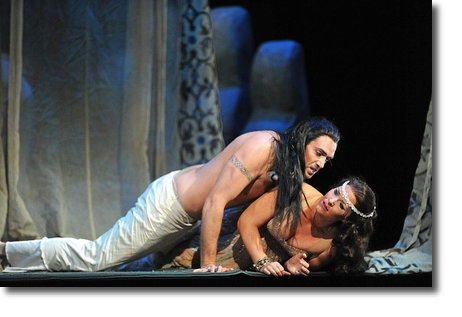
Both McPherson and Lynch, the soprano, gamely threw themselves into the movement required by their roles, but as the evening progressed we became more and more aware of their lack of movement training. Both McPherson and Lynch repeatedly — and painfully, we suppose — clunked their knees on the stage floor because no one had seen fit to teach them stage falls. In a particularly painful portion of Act 2 the lovers met at the pile of rocks that served as the sacrificial virgin’s bed. Though they sang about the joys of physical love, McPherson and Lynch were rendered awkward and obviously uncomfortable in the moments leading up to (assumed) love making. We felt sure that the set crew, sadists all, had refused to tack a layer of high-density foam rubber on top of their bed.
After the lovers are discovered and sentenced to death, baritone Simpson is seen in his tent. There his conscience first leads him toward compassion and mercy. But, after Lynch arrives and unsuccessfully pleads for McPherson’s life, Simpson is seized by a jealous rage and renews the death sentence. Possessed of supple joints and perhaps a pair of (unseen) kneepads, Simpson looked notably comfortable and sexy reclining and kneeling in that scene and his voice rang out rich and strong.
In our opinion, as long as singers are seen as well as heard, they would do well to cultivate movement as well as vocal skills.
No discussion of this production would be complete without mention of the beautifully realized scene designs by Boyd Ostroff. In Act 1 we looked past the pearl fishers’ camp to a pristine bay. In Act 3 the condemned lovers were bound to a rock formation in the shape of a giant hand. But our favorite set was Simpson’s tent (in Act 3?), which, as the scene ended, was drawn up into the flies and revealed to be a single bolt of artfully draped cloth. Simplicity.
To their credit and to the credit of the overall production, the Ground Works dancers managed to make themselves visible in order to add an occasional accent or highlight. Usually Director Kay Walker Castaldo and Choreographer David Shimotakahara took the obvious expedient, brought the dancers front and center, and gave them big, dynamic movements so that they could be seen among the throng on stage.
So on our first trip to the opera we walk away complaining that production assets are in fact liabilities, that singers should be heard but not seen, that nobody can dance like dancers. There was a reason we stayed away from opera for all these years. What alternative do we suggest? Our idea of an opera with dance would be after the model of Balanchine’s 1936 production of Gluck’s Orpheus and Eurydice in which only dancers appeared onstage and musicians and singers performed from the pit. That would be easier on both eyes and ears.
Ground Works Dance Theater performed with Opera Cleveland at the State Theater 9/23 – 9/26/2010. [Photo by Eric Mull.]
 From Cool Cleveland contributors Elsa Johnson and Victor Lucas. Elsa and Vic are both longtime Clevelanders. Elsa is a landscape designer. She studied ballet as an avocation for 2 decades. Vic has been a dancer and dance teacher for most of his working life, performing in a number of dance companies in NYC and Cleveland. They write about dance as a way to learn more and keep in touch with the dance community. E-mail them at vicnelsaATearthlink.net.