Thu 11/10 @ 7-11PM
For a country where poverty and hunger (not to mention climate change) are major issues, the amount of wasted food is not only embarrassing but despicable. One company hoping to make a difference locally is Rust Belt Riders.
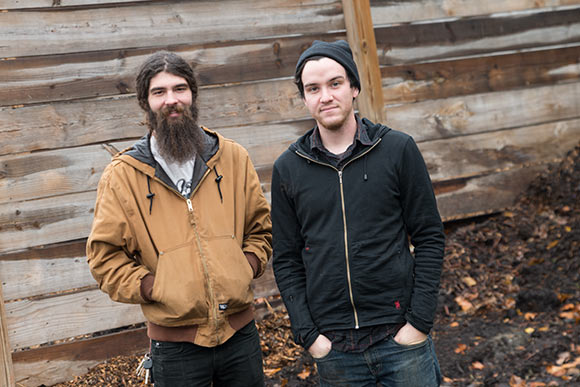
The organic waste hauling service, which was co-founded by Daniel Brown and Michael Robinson, is not only managing and mitigating food waste but also has made it its mission to create awareness in Cleveland area neighborhoods.
The Hamilton Avenue operation currently has a crowdfunding campaign towards a mobile classroom that, once operational, will teach residents about climate change, stormwater management, environmental racism, food access and community building.
The efforts include its upcoming fundraiser “Flip Out Over Food Waste,” which takes place Thu 11/10 at Superelectric Pinball Parlor in Gordon Square CoolCleveland talked to Rust Belt Riders CEO Brown about his company’s composting efforts in Northeast Ohio, as well as this upcoming awareness event.
Let’s start with Rust Belt Riders.
I’ve been around two-and-a-half years. We conceived the idea in 2013 but did our first pickup in June 2014. We manage commercial food waste producers — cafes, grocery stores and hospitals. We basically offer the same service that a garbage company would but the material we pick up go to community gardens and composting sites instead of landfills.
What kind of response have you gotten from the culinary community?
I think we’re kind of building on the heels of the concern around local food and supporting local agriculture. A lot of our clients understand how you manage your waste can have a significant impact on what local agriculture looks like. So you obviously need local soil that’s healthy to grow local produce, and a lot of our clients get that and understand that and are willing to put their money where their mouth is to invest in that. We provide our clients with containers in the same way you receive a dumpster from Waste Management. We then go in and teach all of the staff about what can and can’t be composted. The big no-nos are no meats or cheese. The reason is because that can’t break down in the same way that veggies or fruit can. All of the waste we collect is pre-consumer food waste, not the uneaten food off a plate. It’s more of the material that is wasted during the preparation process.
So lead us through what happens after Rust Belt Riders picks up the waste?
From the time it leaves our clients’ kitchens and cafeterias, we will take it to community gardening sites where we will oversee and manage the composting process. So we work with Ohio City Farm, Cleveland Roots, Kurtz Bros. and a handful of other gardening sites where we drop it off, and then those gardens get to use the soil that we produce. We also take it to Rust Belt Gardens, which is the community garden we started.
Why is composting important?
Roughly 40 percent of all of the food that’s grown in this country is thrown away and never consumed. So the greenhouse gas emissions are related to that would make it the third largest polluter in the world behind the United States and China. Basically when food goes to a landfill it produces methane, and methane gas is 20 times more toxic to the ozone layer than CO2. We do our part to keep that out of the landfills, to avert any pollution that might relate to it.
Is the cost of Rust Belt Riders competitive in the market?
We don’t necessarily think of ourselves as competing with Waste Management because I think we’re offering a slightly different service. It’s really the peace of mind to know your waste is being managed responsibly, being kept in the community you‘re operating in and creating value for your neighbors. Waste Management has real big trucks and real big landfills and that’s really the end of it. It’s really cute to throw things away, and we’re trying to demonstrate to people that there’s value in the material that otherwise would be discarded.
Tell us about the “Flip Out Over Food Waste” event.
In the same way you have a lot of questions of what we do and how we do it, we’re trying to go out into the community and provide a space to begin answering these questions and having these conversations about the issue of food waste. I think a lot of people view the climate crisis as a big insurmountable thing that you need solar panels and wind turbines to begin addressing. What we’re trying to do is work in conjunction with Cleveland Neighborhood Progress and their climate ambassadors who are already out in four different neighborhoods to support their work in developing and supporting solutions to the climate crisis. We’re offering our expertise, which is how to manage food waste, how to avoid food waste, and if there is waste, what are the ways you can process it to provide value for yourself, your family and your community.
Is this the first time Rust Belt Riders have held such an event?
We have done workshops and public events in the past but this will be our first concerted effort to have an ongoing physical location where we can be there to address people’s questions and concerns, and to support organizers’ work that has already taken place. The idea is we have this crowdfunding campaign going on for a mobile classroom we’re repairing, which be hosting these conversations and workshops and classes around climate change and food waste. So with [“Flip Out Over Food Waste”], we wanted to offer a fun way to get a group of like-minded people together to have some fun. The idea is that the $20 contribution to our campaign will get you in the door. We’ll have prizes and free pinball all night for people to just kind of congregate and learn more about food waste.
So the idea is to get people motivated – and to feel less guilty about their food waste?
I think it’s more to identify the solutions to an avoidable problem.
[Photo by Bob Perkowski]