Through Sat 4/4
William Shakespeare’s classic tragedy, Macbeth, produced by Great Lakes Theater at Playhouse Square, explores the down side of power and kingship.
“The Scottish Play,” directed by Sara Bruner, returns to the Hanna Theater still as relevant as it was when first produced during the reign of Great Britain’s King James I.
Yes, different times, different rulers, but the same vanities and ambitions continue to worry today’s humans.
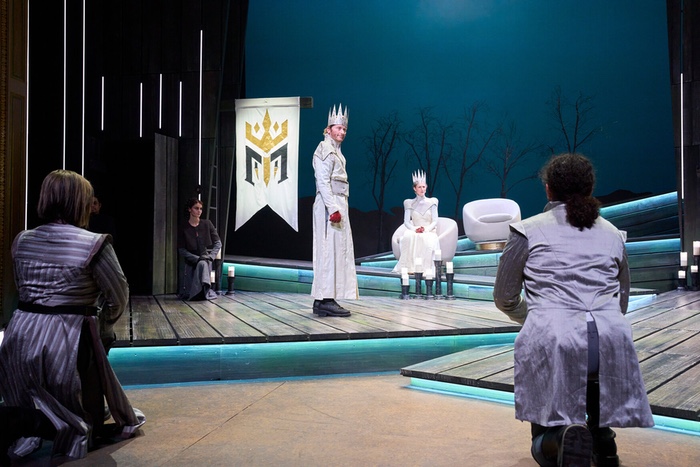
The darkly lit stage, at times making it hard to see who was who and what was going on, provided a forewarning of the evil to come. Small spots of light showed paths and ways out as characters raced around (usually while trying not to be murdered—didn’t work for them most times). But we know this is a tragedy, right?
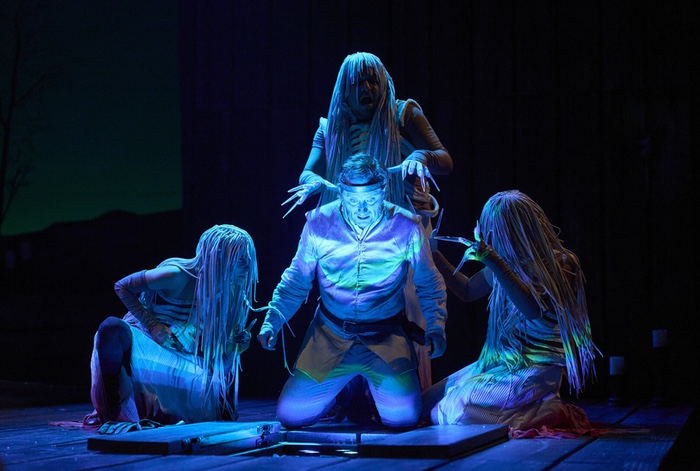
On the same plain wooden level set (basically) as designed by Courtney O’Neill for the last show The Heart of Robin Hood), we see three witches gather to predict the future. (Now tagged “Weird Sisters,” instead of the more traditional “witches,” their forecasts are no more cheerful.)
The Weird Sisters (athletically played by Kelsey Angel Baehrens, Jonathan Contreras and Ángela Utrera) dance around, flashing swirling veils. We sense creepy skeleton vibes.
They tell Scottish noble Macbeth (a somber Jeffrey C. Hawkins) what he wants to hear. His dream to be King of Scotland will come true and he will be unbeatable (or that’s how he interprets their prediction). Macbeth, of course, takes their visions to heart.
When Duncan, King of Scotland (a regal David Anthony Smith), invites himself to spend the night at Macbeth’s castle, we know bad things are on the way.
Once she hears about the royal visit, Lady Macbeth (Cassandra Bissell) encourages her husband’s willingness to murder if that’s what it takes.
And so they do.
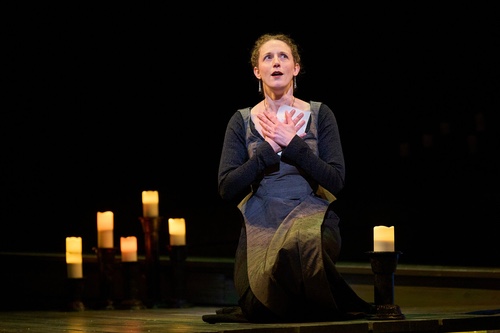
But, as Hawkins and Bissell demonstrate, getting what you want doesn’t always make you happy.
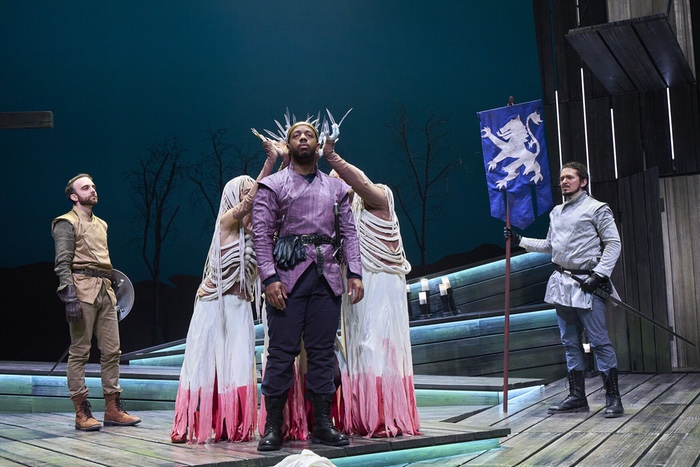
Opposing parties from England, Ireland and Wales, led by Macduff (Joe Wegner), arrive and the battle begins. Eventually, the slaughter will end. That’s as happy as a Shakespeare tragedy can get.
Other resident company members contributing to the current production include Nick Steen (as Banquo), Jessie Cope Miller (as Ross), Avery LaMar Pope (as Malcolm), and Marlowe Miller (as Fleance and then MacDuff’s daughter), Evan Stevens (Donalbain), and Luke Brett (Lennox). Everyone listed above also filled in as servants, killers or whatever was needed at the time.
Credits should also go to Mieka van der Ploeg (whose costumes echoed stark modern styles), Caitie Martin (for floating witch hair), Rick Martin (for the dark Scottish moor), and Matthew Webb (for ghostly spirit sounds).
Bottom Line: Known as one of Shakespeare’s last, shortest and perhaps greatest dramas, Macbeth makes us remember familiar lines (you’ll recognize many metaphors) and respect his genius. A half-quibble: Director Sara Bruner allows the Macbeths—and others—to emote freely in a more American sense. At one point a character lies on the floor in a tantrum, so don’t expect any “British Isles” emotional reserve. It’s true, however, that Mr. and Mrs. Macbeth’s extreme reactions so vividly suggest their remorse that one is left thinking “Why didn’t they see the train wreck coming?” Do we ever?
One Response to “THEATER REVIEW: “Macbeth” @ Great Lakes Theater by Laura Kennelly”
Mike Ballard
The AI bubble, along with the rest, the real estate bubble and so on, including the delusions of grandeur parading around as the current administration of the political State of America…..
Song of the Witches: “Double, double toil and trouble”
By William Shakespeare
(from Macbeth)
Double, double toil and trouble;
Fire burn and caldron bubble.
Fillet of a fenny snake,
In the caldron boil and bake;
Eye of newt and toe of frog,
Wool of bat and tongue of dog,
Adder’s fork and blind-worm’s sting,
Lizard’s leg and howlet’s wing,
For a charm of powerful trouble,
Like a hell-broth boil and bubble.
Double, double toil and trouble;
Fire burn and caldron bubble.
Cool it with a baboon’s blood,
Then the charm is firm and good.