Recently, I ate lunch with a retired pastor who’s devastated by what’s going on in our world. He retired early because he couldn’t stand up at the pulpit to preach about human rights without breaking into tears. The pain on his face and in his voice encapsulated this moment in history for me as well. We are from the Methodist tradition of mission work and standing up for social justice and having quiet moments with people who show up for community meals. It’s difficult to wrap our heads around anger that results in mistreatment of people.
On the Sunday prior to Martin Luther King Day, I watched a video of the Reverend Dr. Martin Luther King, Jr. speaking while our church organist played a medley of civil rights songs on the piano. King said he was not afraid because he was called to do the work he was doing. What made my eyes tear up was not only his courageous message but the knowledge that he would soon die for speaking the truth with courage. When a friend turned to look at me, wet tears were running down her face as well. I said, “We were there,” she nodded, and we hugged.
Dr. King said, “The ultimate measure of a man is not where he stands in moments of comfort and convenience, but where he stands at times of challenge and controversy.” And here we are, in the most challenging time since the Civil War when brothers fought in separate armies. The divisions we have today make us unable to talk to our relatives about what’s happening in the country we love and believe in. What happened to Declaration of Independence and the U.S. Constitution that became beacons of what freedom and democracy look like?
This is not about politics so much as it is about our vision and belief in what is right. It’s about morality. In a recent theology class, we discussed the inner compass in the human soul, love and grace, the human condition, and the knowledge of Truth. In our current world culture, “truth” is different for everyone, so how do we get back to our shared vision? How do we get back to acting from a place of moral values and moral truth?
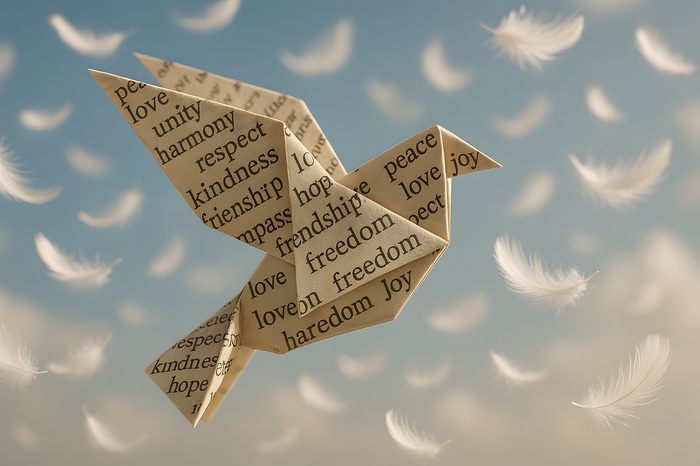
When I watch videos of monks walking across our country in the name of peace, when I watch the people of Minnesota stand up for freedom, and when I hear those with a bigger audience that say, “This is wrong, it has to stop,” I feel hope. We need hope to carry on, to take a stand, to be a beacon to the world. I liked it when the rest of the world looked at us as an example. I want to be part of a federal republic that stands for freedom, diversity, and global leadership.
Sixty years ago, my father, a white United Methodist minister serving a Black American church during the Civil Rights Movement, who marched in Birmingham and Washington, took a tall stand. I can still hear the cadence and rhythm of Dad’s voice when he said good night to me in the summer of 1968, the first night he went to Akron’s riot zone to stand between whites and blacks, between police and the community. Dr. King was my father’s hero because he stood up for justice.
When I cried in church, I was thinking about how much we’ve recently lost and about how people were silenced by an authoritarian regime during World War II. People waited too long to speak up. Here’s the thing: if we remain silent, we’re part of the problem.
Here are my questions: Do we want immigrants, who are at the heart our country’s very existence, treated with indignity? Do we want indiscriminate killing of our citizens who are speaking out for human rights or who just happen to be in the wrong place? Do we want our democracy to crumble into an authoritarian state after all we’ve fought for? Do we stand for human rights, equality, justice and freedom?
Dr. King wrote in 1957, that “Life’s most persistent and urgent question is, “What are you doing for others?” “Doing for others” means being kind, but it also means standing up to injustice. Our way out of doom and gloom is action, not just by serving food and comforting friends, but also by speaking out about human rights and human dignity. We are living through a dark time, but we can hope the light will overpower darkness. We need to hope.