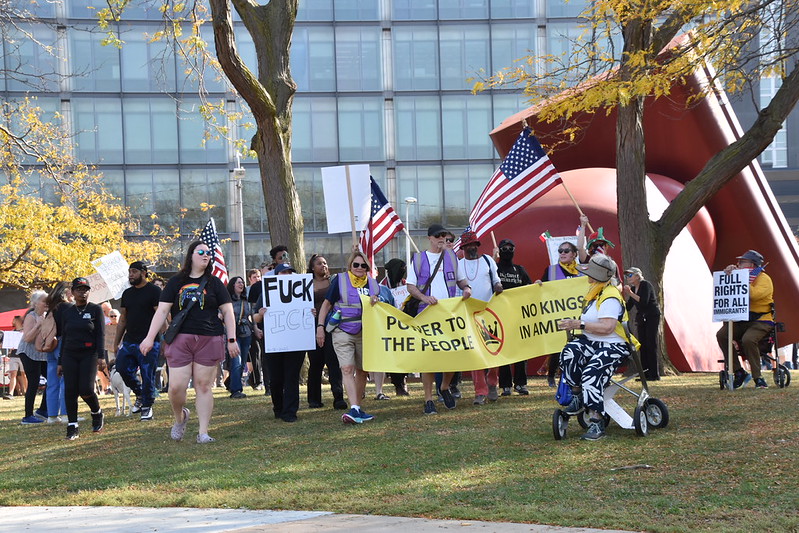
Something remarkable happened a few days ago. Thousands of people gathered near the Free Stamp in downtown Cleveland to rally against the Trump administration in the No Kings Rally. Mayor Bibb and Congressional Representative Shontel Brown spoke in fiery defiance, energizing the crowd. The protest continued peacefully up East 9th Street towards Public Square before returning to Willard Park.
The Free Stamp is an aluminum and steel work of art by Claes Oldenburg (1929-2022) and Coosje van Bruggen (1942-2009). The pop art structure is 49 feet long, 28 feet high, and weighs 70,000 pounds. Their other works include a 45-foot clothespin, a giant badminton birdie, and a permanent large-scale sculpture titled Floor Burger, plus many more.
The Amoco Company commissioned the Free Stamp in 1982, intended to remain permanently installed in front of the Standard Oil of Ohio building at 200 Public Square. Four years later, Amoco sold the building to BP America. BP America refused to install the sculpture, believing the message was too controversial. Oldenburg is on record as saying that “free” references the emancipation of American slaves during and after the Civil War.
Cleveland also has the Civil War-era Soldiers’ and Sailors’ Monument, representing freedom from slavery in Public Square, which honors 10,000 Cuyahoga County residents who fought in the Civil War.
Free Stamp sat in a warehouse in Illinois for five years before then-mayor George Voinovich invited Oldenburg and van Bruggen to Cleveland to locate another site. They selected Willard Park on Lakeside Avenue; BP agreed to gift the Free Stamp to the city of Cleveland, with all installation and maintenance expenses covered.
Free Stamp was to be installed with the word “FREE” facing down, but disagreements arose. Cleveland city planners felt that this approach was not right. As a result, they installed it with the faux-rubber “FREE” proudly visible.
Oldenburg agreed to the changes and reportedly said it was “as if a giant hand picked up the Free Stamp and angrily hurled it several blocks to its current location.”
For Oldenburg and van Bruggen, Free Stamp reinforced the notion of freedom of expression and freedom from corporate ownership, two ideological positions currently under attack by the Trump administration, making the site for the No Kings relevant. Every year, dozens of protests take place in front of the sculpture for civil rights, fair housing, and social equity, making the work of art a significant symbol for those groups willing to express their beliefs publicly.
Art has always played a role in revolutions by serving as a tool for propaganda, protest and inspiration, helping to shape public opinion and define revolutionary ideals by communicating ideas and emotions that are not easily expressed in words. At best, art can serve as a powerful means to critique the ruling class and authoritarian structures, forcing viewers to confront uncomfortable truths about society and politics; revolutions help foster the growth of new artistic styles and forms of expression. The 1917 Russian Revolution spurred Russian Constructivism, characterized by a focus on geometric forms, industrial materials and utilitarian design, as artists sought to break from tradition and create art for a new society.
During Nazi Germany, officials arrested artists and forced them to flee or hide, while they confiscated, sold or destroyed their work.
In February 2021, the Wiener Holocaust Library began a one-year project to digitize its rare collection of Tarnschriften (disguised anti-Nazi resistance pamphlets), as well as a small cross-section of the library’s wider pamphlet collection. Tarnschriften, or “hidden writings,” is used to describe the vast number of publications that were produced covertly by a variety of anti-Nazi groups between 1933 and 1945 as a form of political resistance to the Nazi Party’s rule. Pamphlets offered practical advice to help German citizens navigate the Third Reich. A few Tarnschriften feature articles on the Nazis’ persecution of Jews.
A pamphlet, titled “On the Dangers That Threaten Every Household: A Guide for the Housewife” and featuring an advertisement for Lysol Disinfectants on the back cover, actually hides anti-Nazi and anti-war material under headings like “German Women Are Sorry and Unhappy” and “And What About the Upbringing of Children?” A sample of a Lyons Tea packet concealed inside contained anti-war and antifascist propaganda to inspire dissent against Nazi rule.
One publication informed readers how to navigate city traffic on a bike.
Many groups produced Tarnschriften, including the German Communist Party (KPD), Social Democratic Party (SPD), New Beginning, Communist Party of the Soviet Union (CPSU), Comintern (Communist International), the Black Front, the German Popular Front, German Communist Youth (KJD), and Catholic organizations. Some were anonymous to avoid prosecution and have no named author.
During the 1960s, the official newspaper of the Black Panther Party used posters and other graphics as a tool for community organizing and spreading their message. Led by Minister of Culture Emory Douglas, the newspaper featured powerful illustrations and political cartoons that documented police brutality, connected party chapters across the nation, and rallied support for their cause.
A wide range of creative and illustrative posters calling for Trump’s removal from office were among the thousands of protesters in Cleveland for the No Kings Rally. Others poked fun at the president by saying, next to a picture of Trump, “Does this ASS make my country look small?”; “No-Faux-King Way”; “86 47”; “No Kings in the US Since 1776”; or perhaps the most sorrowful, “My Husband Did Not Die for This.” Still others called for the release of the Epstein files, with photos of a young girl sitting on the president’s lap. Some demanded health care and protection for immigrants, including lyrics from the Bob Marley song, “Get up, stand up. Don’t Give Up The Fight!”
If we are to win this fight, and we can, artists must shape public opinion and forge revolutionary ideals, leave behind the institutional slag that has become stagnated and stale, and propel a cultural movement to change the current political system.