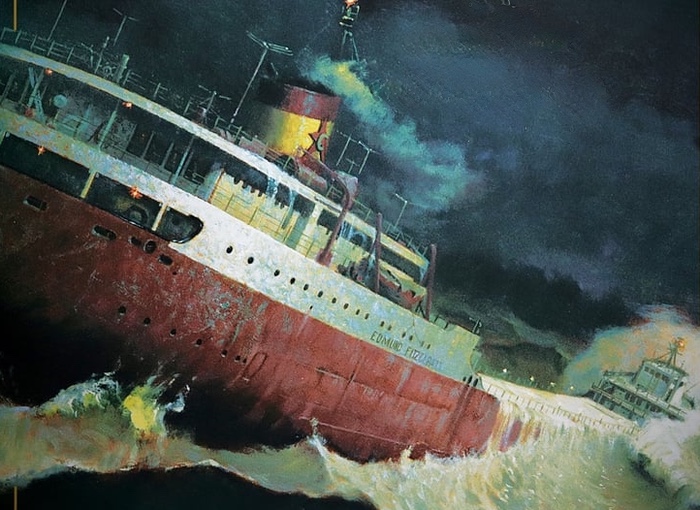
It has been 50 years since November 10, 1975, the fateful date of the sinking of the Great Lakes freighter, the SS Edmund Fitzgerald. Fifty years since all twenty-nine members of her crew went to their watery graves, 530 feet below the icy waters of Lake Superior. A new book, The Gales of November – The Untold Story of the Edmund Fitzgerald by John U. Bacon, sheds new light on the tragedy, the crews — four of whom were from the Cleveland area — and the mystery that surrounds an event that has captured the imagination of the nation for the last five decades.
John U. Bacon is a bestselling author who has written 14 books about various aspects of Michigan and its history. This new work weaves into the saga of the Fitzgerald relevant aspects of Michigan history, the Great Lakes and the economy that has grown up around the lakes since the French started to engage in fur trading in area in the early part of the 1600s.
Since its publication in October, the book quickly shot up to the top of several bestsellers list and has been named one of the top ten history books of 2025. After reading it, I can clearly see why.
Bacon’s haunting account of the final voyage of the Fitzgerald captures the reader from the first page. For those who have heard the mournful folk-rock ballad by Gordon Lighfoot, “The Wreck of the Edmund Fitzgerald,” the book confirms the adage alluded to in the — truth is stranger than fiction.
The story of the Fitzgerald starts when the 729-foot vessel was launched on June 7, 1958. For the next 17 years she carried taconite (a variety of iron ore) from mines along the Minnesota Iron Range near Duluth, to iron works in Detroit, Toledo, Cleveland and other Great Lakes ports. Called a variety of names, including “The Mighty Fitz,” she was known for her luxurious interior, a rarity on Great Lakes freighters, excellent cuisine and special cabins for VIP guests, who occasionally joined the crew. At the time of her launch, she was the largest freighter on the Great Lakes and remains the largest to have sunk there.
As a workhorse of the fleet, she set season haul records for tonnage and speed six times, often breaking her own records. And it was not unusual for the captains and the crew to push the limits of the ship and her capacity, to break records and increase profits.
Crowds often came to watch her go in and out of ports, especially when passing through the Soo Locks (between Lakes Huron and Erie) where, in the 1960s, the ship’s captain, Peter Pulcer, would pipe music over the ship’s intercom during the passing and offer a running commentary for observers about her size and performance records.
In telling the story of the Fitzgerald, Bacon delves into the lives of her crew and explains how their months aboard the Fitzgerald created a kinship and comaraderie. Many crew members were second and third generation Great Lakes sailors. They spent months together in confined quarters away from their families, worked long hours and fraternized during shore leaves. Although the hours were long and difficult, the pay was good and many looked forward to an early retirement and a good pension. Several members of the final crew, including its captain, Ernest McSorley, one of the most experienced and capable captains on the Great Lakes, had planned on retiring after this final voyage.
Bacon offers the reader a valuable account of the importance of the Great Lakes iron ore industry to the national and world economy. He gives informative accounts of the differences between plying the waters of inland, freshwater water ways and the saltwater oceans of the world, asserting that the Great Lakes can be much more dangerous than the open seas.
The exact reason for the sinking of the Edmund Fitzgerald will never be known. However, Bacon offers some new clues. Captain McSorley chose to make one last voyage, and as Gordan Lightfoot says in his ballad, “as the witch of November come stealin” — pushing his luck for one more run before the end of the season.
Because of the length and intensity of the storm the Fitzgerald faced in her final days, McSorley and his crew may have been suffering from physical and mental fatigue. Voice communications records indicate that McSorley and members of his crew may have been on duty for 24 hours or more. This may have impaired their judgment.
Investigators have found that the charts used by the crew were outdated and did not adequately show underwater hazards that may have damaged the ship’s keel. This is coupled with a once-in-a-century storm that the National Weather Service failed to adequately predict.
There is also the possibility that ship was showing its age, with evidence that the structural makeup of the ship was near or at its breaking point. The bottom line is that likely everything that could have gone wrong went wrong on this final voyage.
Out of every tragedy, there usually comes some good. The Fitzgerald was the last commercial ship to sink in the Great Lakes. The tragedy forced the Great Lakes shipping industry to review procedures and upgrade equipment. New technology and additional regulations and inspections have enhanced overall safety and new rules are more strictly enforced. Crews are better trained and equipped, and the Coast Guard and National Weather Service are better equipped to predict storms.
Gordon Lightfoot sums up the tragedy in the first verse of his haunting ballad which is printed in the final pages of the book, a book that will enthrall and intrigue you and hold your interest from the first to the last page. It’s a must-read for your 2026 reading list.
The legend lives on from the Chippewa on down
of the big lake they call Gitche Gumee
The lake, it is said, never gives up her dead
When the skies of November turn gloomy
With a load of iron ore twenty-six thousand tons more
Than the Edmund Fitzgerald weighed empty
That good ship and true was a bone to be chewed
When the gales of November came early.
Songwriter: Gordon Lightfoot
“The Wreck of the Edmund Fitzgerald” lyrics copyright Waarner Chappell Music, Inc.

C. Ellen Connally is a retired judge of the Cleveland Municipal Court. From 2010 to 2014 she served as the President of the Cuyahoga County Council. An avid reader and student of American history, she is a former member of the Board of the Ohio History Connection, and past president of the Cleveland Civil War Round Table, and is currently vice president of the Cuyahoga County Soldiers and Sailors Monument Commission. She holds degrees from BGSU, CSU and is all but dissertation for a PhD from the University of Akron.
4 Responses to “BOOK REVIEW: The Gales of November: The Untold Story of the Edmund Fitzgerald by John U. Bacon, review by C. Ellen Connally”
Linda Rich
Great I turned review! Based upon this article, I will probably read this book
Mel Maurer
Thanks Ellen. From your review it seems this is a book that mighty ship and its crew deserves, covering all aspects of Great Lake shipping and the crews that make it possible. May God bless them and those that continue to navigate Great Lakes waters,
Mike Maurer
Excellent review! I’ve set a goal of reading 50 books in 2026, and am going to start with this one. Thank you!
MARK J ILG
Thank you Ellen. After just finishing it, I can say you absolutely nailed it. John U. Bacon wrote an incredible and detailed book. Hundreds of stories well assembled told the story of the Edmund Fitzgerald. I morn the brave crew. Thank you again.